23
VIII. SYSTEMS WITH LARGER NUMBER OF DOOR ENTRY UNITS
A larger number 700 series units can be connected together in one system. In
this setup the same receiver can be called from different door entry units: at entry
gates, at building entrances or floor entrances, etc.. Typically, the first door entry
unit in the system is a Master unit and all downstream units are Slave units, in
any number. The exception is a system with optional modules such as SW4S-
DIN (support up to 1020 apartments, only in INSPIRO+) or CDN-MM (multi
master module). In both cases, more Master units can be connected (refer to the
introduction of this manual or to CDN-MM manual for details).
A system with multiple door entry units is operated same way as a single door
entry unit, refer to "OPERATION” for description.
The receiver will open the door or control the second output (F2) only in that unit
from which connection was made. In video systems, the image in the monitor will
be displayed from the camera of the unit, from which connection is made. Other
units in the system that can communicate with the receiver being called (from
which a call to the receiver can be made) will display "Busy" and their keypad
will be locked. Then door can only be opened using the ACC proximity reader.
When the call is completed (line is released), "Busy" will automatically disappear
and the keypad will unlock.
In extensive systems, several calls can be made simultaneously from different
units. If the display shows no "Busy”, the unit can be used to call a receiver
connected to the line which is free at this moment. If the line is busy with another
call, "Busy" will appear a short while after attempting to make a call.
Note! Only those receivers that are physically connected "behind" (or
downstream) the door entry unit - can be called. No “reverse” call is possible - a
call to receivers connected “before" (or upstream) the unit from which the call is
to be made.
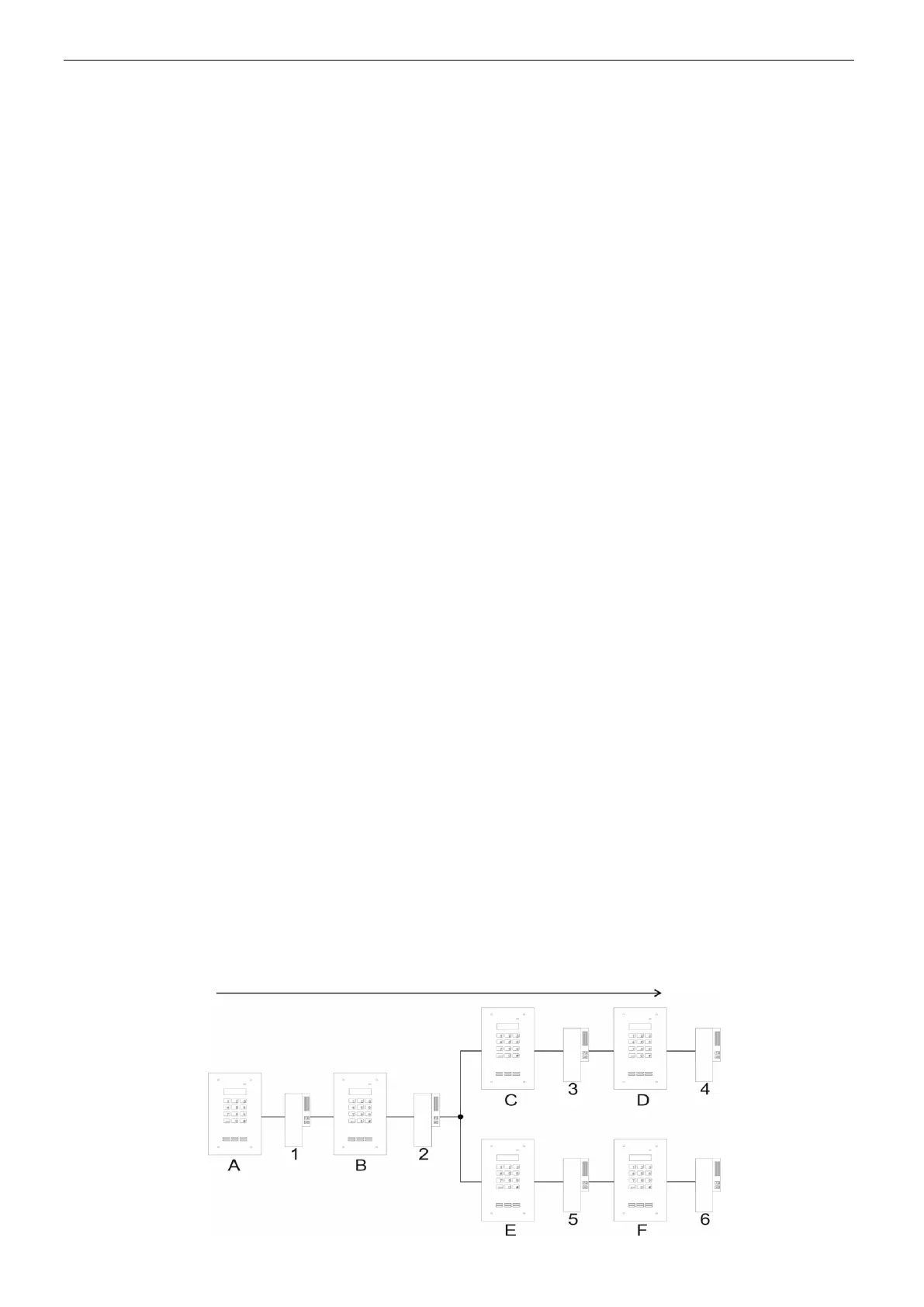
Calling and connection topology "Slave" units is presented in the figure below
("A": Master, "B, C, D, E, F": Slave).
Door entry unit "A" can call all receivers, "B" can call all receivers except "1", "C"
can call "3" and "4", "D" can call "4". Similarly, "E" can only call "5" and "6", and
"F" can only call "6". Several calls in the system: when calling receiver “4” from
door unit A, units "E and F" can be used at the same time (others will display
"busy"). When using "B" to call "3", "A" can be used to call "1", "D" can be used
to call "4", E can be used to call "5 and 6", "F" can be used to call "6", and so on.
It is possible to set any number of parallelly connected C, D and E, F branches.
Call direction



 To Next Page