Connection to the Network
47
The expected phase error (1000 ns) and frequency error (2 x 10
-11
) must be compared
with the expected test results: PRTCs (ITU-T G.8272 clocks) must supply an accuracy
level in terms of TE better than 100 ns and the PRC (ITU-T G.811) accuracy in terms
of frequency offset is 1 x 10
-11
or better. It is clear that xGenius configured in holdover
mode will not provide the accuracy level required to assess compliance with the G.7272
and G.811 frequency and phase requirements. On the other hand, ITU-T G.813
requires a frequency offset smaller or equal than 4.6 ppm for oscillators claiming
compliance with this standard and ITU-T G.8271.1 specifies an MTIE of the order of
hundreds of nanoseconds for a test period of 10000 seconds. For these test cases,
holdover operation may be appropriate.
All previous examples are based in a comparison between the
expected test error
and the magnitude to be measured. Sometimes, the limiting factor could be
not the magnitude to be measured but the test resolution or other error
sources. An example of this is latency measurement in E1 and T1 interfaces.
The expected accuracy level in these tests is two or three microseconds with
perfect timing. For this reason, an error of hundreds of nanoseconds hardy
matters.
Aging is not the only factor that limits the accuracy of an oscillator. Magnetic fields, air
flows, mechanical vibrations and among all them temperature have the capacity to
modify the oscillator frequency.
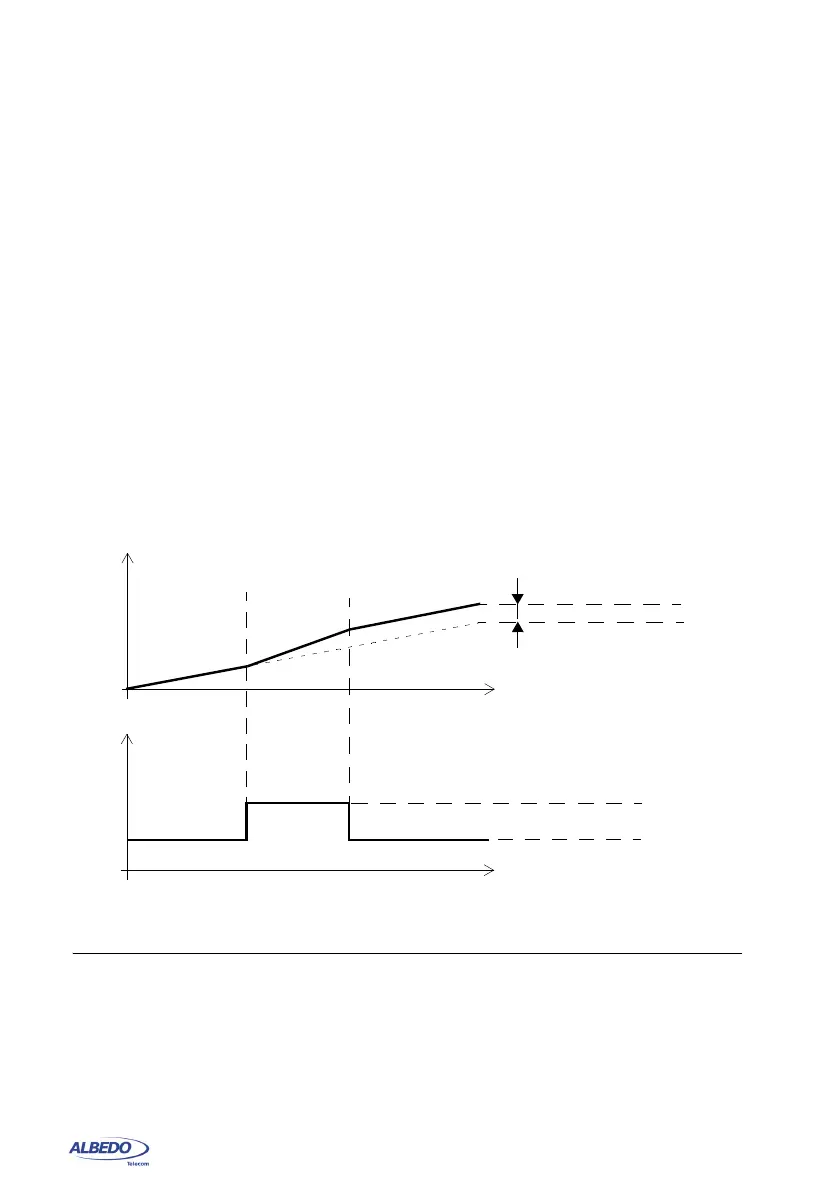
For the example of the Rubidium xGenius, the holdover accuracy of 1000 ns in 24
hours applies only to operation with temperature changes within ±2 ºC. If the
Figure 2.6: Temperature induced TE when the equipment is operating in holdover.
TE (ns)
Time (s)
Temperature (ºC)
Time (s)
25ºC
5ºC
Temperature induced TE


 To Next Page