©2019 ALL-TEST Pro, LLC All Rights Reserved 20 Rev 06/20/2019
• Contamination, moisture, chemical changes or any build up
The actual capacitance for each motor is unique to that motor and will differ from any other
motor, even motors of the same size and type. However, when the insulation system becomes
coated with foreign matter, such as grease, cement dust, carbon dust or any other material, it
will cause changes in capacitance. By measuring this value on a new motor and trending it over
time provides indication of debris buildup or contamination, moisture absorption, chemical
reaction or thermal degradation of the insulation system.
Dissipation Factor (DF)
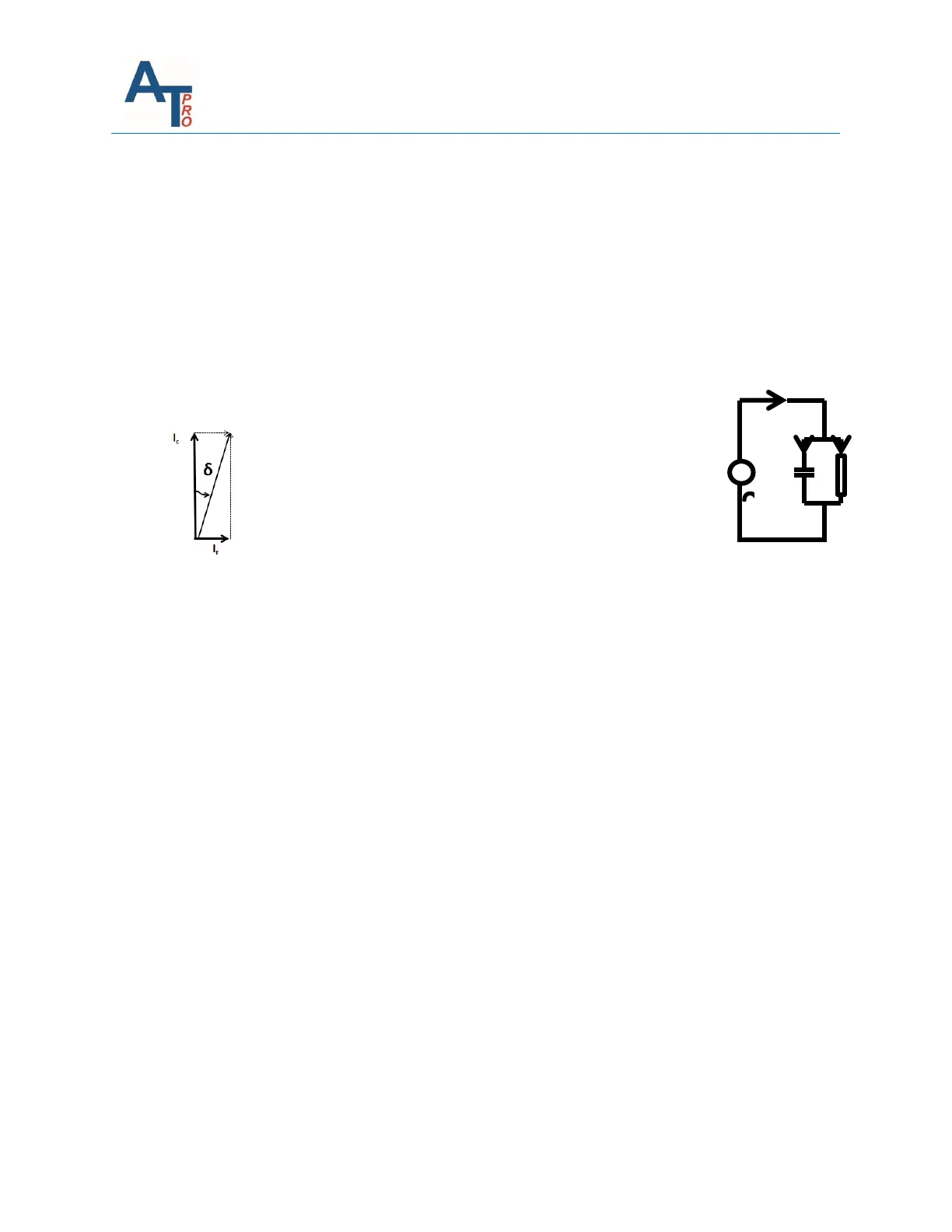
Since the insulation material forms a capacitor, an AC voltage
applied across the insulation will cause the system to
react as a capacitive circuit. Ideally the electrical
equivalent circuit would be a simple capacitive
circuit, and all of the current through the circuit
would be capacitive. However, in real life the
equivalent electrical circuit will be a parallel RC
circuit. Some of the current will be capacitive I
c
while some of the circuit will be resistive I
r.
The
two currents have a phase difference of 90
0
. The DF is the ratio of the resistive current to the
capacitive current. DF = I
r
/ I
c
. It is also referred to as the tan δ.
DF testing is widely used on electrical equipment such as power transformers, circuit breakers,
generators and cables. Also, DF values, trended over time, can help in detecting problems like
contamination, high moisture content and the presence of voids in insulation.
When the insulation system begins to degrade or becomes contaminated, the DF will increase.
In addition, the DF is temperature dependent. Measuring DF at too high or too low temperature
can introduce errors, and the IEEE recommends performing DF tests at or near 68
0
F (20 °C).
INS - Insulation Resistance to Ground (IRG)
IRG is the most common electrical test performed on electrical systems. The IRG test is
performed by applying a high dc voltage between de-energized current- carrying conductors,
(windings) and the machine casing or earth.
According to IEEE Std 43, the insulation resistance is measured after applying DC high voltage for
1 minute. The motor should be above dew point temperature before testing if possible. It is
important to correct values to a reference temperature (typically 40° C) so that trends and
changes in insulation resistance can be readily detected. Contamination, humidity, temperature,
and other factors affect insulation resistance values.
The standard recommends choosing test voltages for insulation resistance testing:



 To Next Page