©2019 ALL-TEST Pro, LLC All Rights Reserved 48 Rev 06/20/2019
DC Compound Dual Voltage Motors
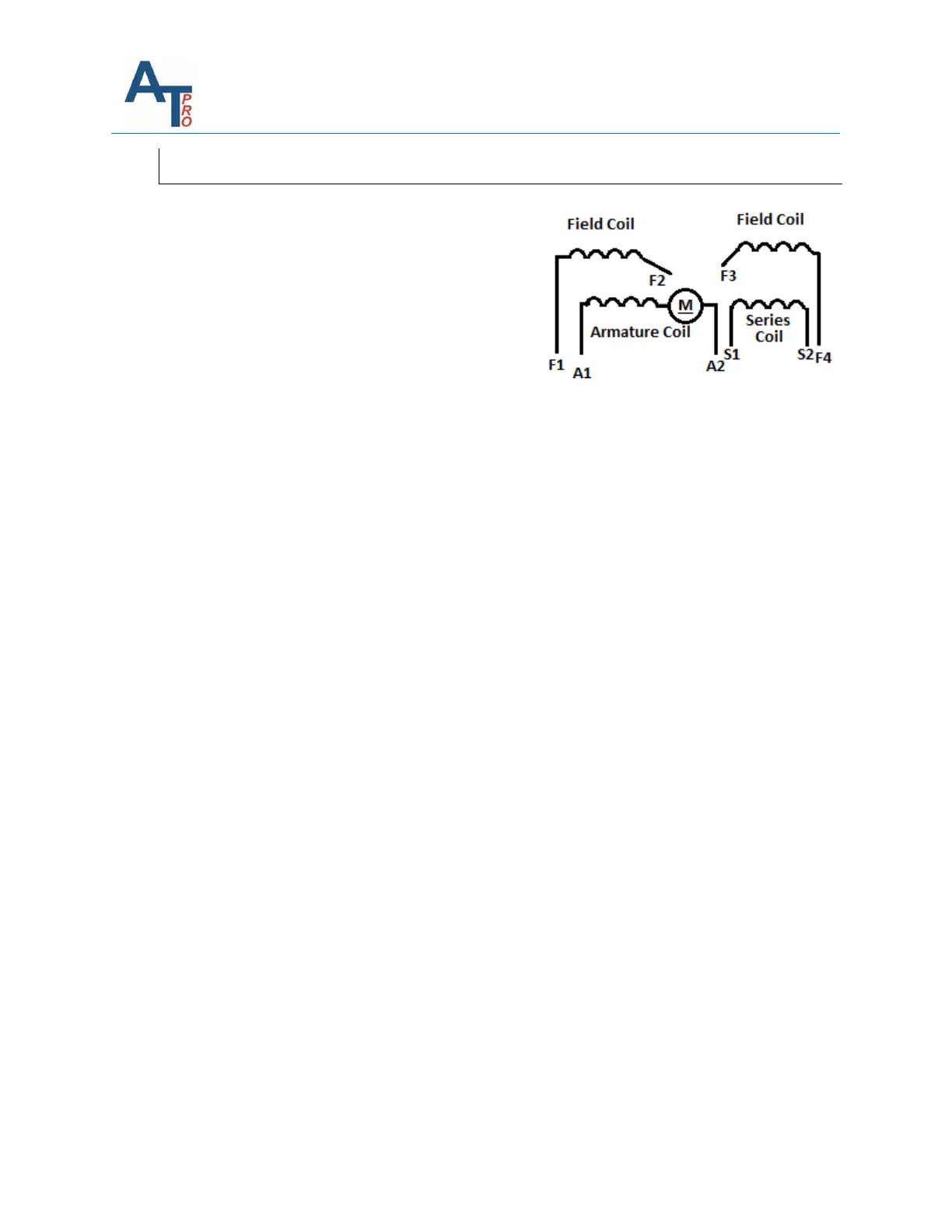
Compound dual voltage motors normally have 2
separate shunt fields, which are in parallel with the
armature field and 1 series field, which is in series
with the armature field. For testing DC compound
dual voltage motors the shunt field windings are
tested individually by themselves. The series and
armature winding are each tested together as in a
DC series motor.
The armature leads are normally labeled A1 & A2, the field coil leads for the shunt field 1 coil
are normally labeled F1 & F2, the field coil leads for the shunt field coil 2 are normally labeled F3
& F4, and the field coil leads for the series field coil are normally labeled S1 & S2. For the
windings to be in series, A2 & S1, or S2 & A1 are connected. Test the series and armature
windings by connecting the AT5™ test leads to free- end on the armature lead and the free end
of the field coil.
It is recommended to take the shunt field winding 1 first, the shunt field winding 2 second and
the armature winding and series winding third.
Note: Always remeasure the armature windings to look for carbon build up.
Since the Field leads are parallel to the armature windings, separate IRG measurements are
taken from the field coils to Ground or the frame and the armature coils to ground or frame a
third Insulation resistance measurement is taken from the field coil to the armature coil.
INS1 = field windings to ground
INS2 = armature windings to ground
INS3 = field winding to armature winding
STATIC readings for DC Shunt Dual Voltage Motors
DC1 = Series & Armature Coil
DC2 = Field Coil 1
DC3 = Field Coil 2



 To Next Page