Speed Signal Inputs
The DGC-500 uses signals from the voltage sensing inputs and magnetic pickup input to detect machine
speed.
Voltage Sensing Inputs
Generator voltage applied to the DGC-500 voltage sensing inputs is used to measure frequency and can
be used to measure machine speed.
Sensing voltage is applied to terminals P23 (A-phase), P26 (B-phase), P29 (C-phase), and P30 (Neutral).
Magnetic Pickup Input
The voltage received from the magnetic pickup is scaled and conditioned for use by the internal circuitry
as a speed signal source.
Magnetic pickup connections are provided at terminals P39 (+) and P40 (–).
Contact Input Circuitry
The DGC-500 has four contact sensing inputs: Emergency Stop and three programmable inputs.
Emergency Stop Input
This input accepts Form A, dry contacts. An open circuit at this continuously monitored input initiates an
emergency stop. An emergency stop removes operating power from all DGC-500 output relays.
Emergency stop contact connections are provided at terminals P35 and P37.
Programmable Inputs
Each programmable input (PROG INPUT1, PROG INPUT2, and PROG INPUT3) can be independently
configured as an auto transfer switch input, single-phase override input, low coolant level input, fuel leak
detection input, battery charger failure input, or an auxiliary input. By default, each programmable input is
disabled.
The programmable inputs accept normally open, Form A contacts. A contact is connected between a
programmable input and the negative side of the battery voltage. Through BESTCOMS software, each
programmable contact input can be assigned a name (eight characters, maximum) and configured as an
alarm input, a pre-alarm input, or neither. The default names for the inputs are AUX IN 1, AUX IN 2, and
AUX IN 3. When a programmable contact input is closed, the front panel display shows the name of the
closed input if it was programmed as an alarm or pre-alarm input. Alarm inputs are annunciated through
the Normal display mode screens of the front panel. Pre-alarm inputs are annunciated through the
Alternate display mode screens of the front panel. If neither is programmed, no indication is given.
Programming an input as neither is useful when a programmable input is used to close one of the DGC-
500's programmable outputs.
Connections for the programmable inputs are provided at terminals P2 (PROG INPUT1), P3 (PROG
INPUT2), and P4 (PROG INPUT3). The negative side of the battery voltage (terminal P21) serves as the
return connection for the programmable inputs.
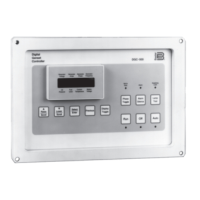
Front Panel HMI
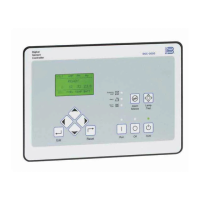
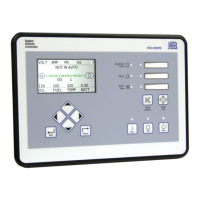
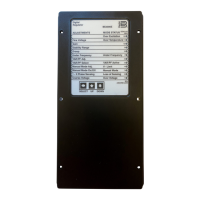
The front panel HMI provides a convenient interface for viewing system parameters and for controlling the
DGC-500 and generator operation. Front panel HMI components include an LCD (liquid crystal display),
LEDS (light emitting diodes), and pushbuttons.
LCD
The backlit LCD provides metering, pre-alarm, and alarm information. Detailed information about the LCD
is provided in the Software Operation sub-section.
LEDs
The LEDs indicate pre-alarm and alarm conditions along with DGC-500 status and generator status.
Pushbuttons
The pushbuttons are used to scroll through and select parameters displayed on the LCD, change
setpoints, start and stop the generator, and reset alarms.
9355400990 Rev H DGC-500 Functional Description 3-3


 To Next Page