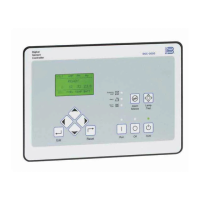
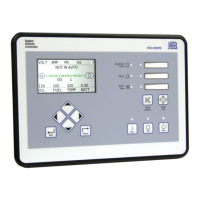
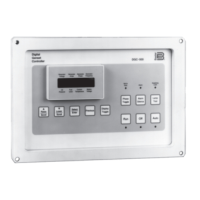
Remote Display Panel
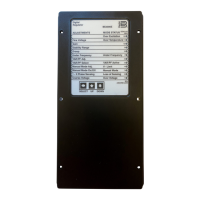
Applications that require remote annunciation can use Basler Electric’s Remote Display Panel, RDP-110.
Using the RDP-110 with the DGC-500 meets the requirements of NFPA Standard 110. The RDP-110
uses a standard, two-terminal RS-485 interface to communicate with the DGC-500 and receives
operating power from the DGC-500. Remote indication of many pre-alarm and alarm conditions is
provided by the RDP-110.
The following pre-alarm conditions are indicated by LEDs on the RDP-110 front panel.
• Low coolant temperature
• High coolant temperature
• Low oil pressure
• Low fuel level
• Weak battery
• Battery overvoltage
• Battery charger failure
The following alarm conditions are indicated by LEDs and an audible alarm on the RDP-110 front panel.
• Low coolant level
• High coolant temperature
• Low oil pressure
• Overcrank
• Overspeed
• Emergency stop
• Fuel leak/fuel level sender failure
• Engine sender unit failure
Additionally, the RDP-110 indicates when the DGC-500 is not operating in Auto mode and when the
generator is supplying load.
For more information about the RDP-110, request Basler Product Bulletin SNE-2.
RS-232 Communication Port
The communication port, located on the rear panel, consists of an optically isolated female DB-9
connector. The RS-232 connector serves as a communication interface for enhanced DGC-500 setup.
Communication requires a standard 9-pin serial communication cable connected between the RS-232
communication port and a PC operating with BESTCOMS-DGC500-32. BESTCOMS is a Windows®
based communication software package that is supplied with the DGC-500. A detailed description of
BESTCOMS is provided in Section 4, BESTCOMS Software.
SAE J1939 Interface (Optional)
A Controller Area Network (CAN) is a standard interface that allows communication between multiple
controllers on a common network using a standard message protocol. DGC-500 controllers with a style
number of XXJX have a CAN interface that supports the SAE J1939 message protocol.
Applications using an engine-driven generator set controlled by a DGC-500 may also have an Engine
Control Unit (ECU). The CAN interface allows the ECU and DGC-500 to communicate. The ECU reports
operating information to the DGC-500 through the CAN interface. Operating parameters and diagnostic
information, if supported by the ECU, are decoded and displayed for monitoring.
The primary use of the CAN interface is to obtain engine operating parameters for monitoring speed,
coolant temperature, oil pressure, coolant level, and engine hours without the need for direct connection
to individual senders. Table 3-1 lists the ECU parameters and Table 3-2 lists the engine configuration
parameters supported by the DGC-500 CAN interface. These parameters are transmitted via the CAN
interface at preset intervals. The columns labeled Update Rate show the parameter transmission rates.
This information can also be transmitted upon user request.
3-4 DGC-500 Functional Description 9355400990 Rev H


 To Next Page