UF V (E3) 03/2019 Page 35/116
Protection principle of the hose burst protection
The hose burst protection device serves to protect the environment against flooding caused by burst water
hoses. It is intended for the operation of the device at a tap water line. If the freezer is operated in a cycle
of cooling water or air conditioning water, the user should check whether the hose burst protection device
provides sufficient protection. This depends mainly on a sufficient medium pressure in the system.
Whenever a strong water flow of approx. 18 l / min. occurs, e.g. caused by a burst water hose, a valve
automatically cuts off the water supply, which can be heard as a clicking noise. The water supply now
remains shut until it is manually released.
Assembly:
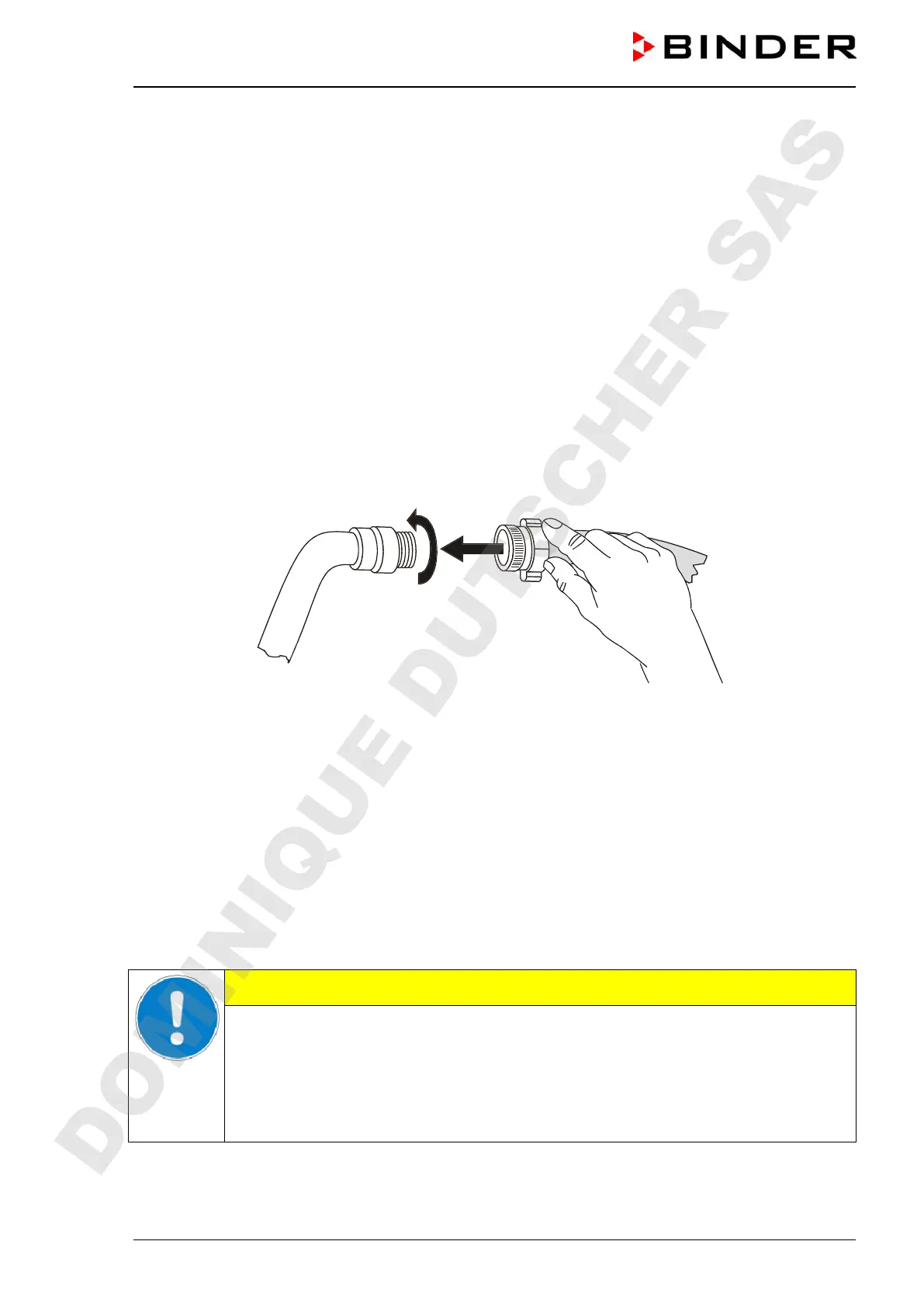
Screw the hose burst protection device onto a water tap with a G¾ inch right turning thread connection.
The connection is self-sealing. Establish the connection between the safety kit and the chamber with a
part of the supplied hose. Protect both ends of the hose by the supplied hose clamps.
We recommend connecting the hose as the last step in order to avoid twisting the hose while screwing on
the safety kit.
Open the water tap slowly in order to avoid actuating the hose burst protection device.
Figure 20: Assembly of the connection kit
Release of the reflux protection device:
In case the burst protection device has interrupted the water supply, first find the reason and remove it as
necessary. Close the water tap. Release the valve by a half left-turn of the upper knurled part. You can
hear the release of the valve as a clicking noise. Tighten the burst protection device against the water tap
by a right turn. Open the water tap slowly afterwards.
Maintenance of the assembly of the hose burst protection device:
Calcification can impair valve function. We recommend an annual inspection by a skilled plumber. The
plumber should remove the safety kit to check the valve by hand for proper function and calcification or
blockage.
CAUTION
Danger of calcification.
Impairment of valve function.
Have a plumber inspect the valve annually.
Remove calcifications by citric acid or acetic acid solutions.
Continue by testing the function and tightness of the mounted unit.
Check: Quickly open the water tap while there is no chamber connected – the valve should cut off the
water flux without any delay.
DOMINIQUE DUTSCHER SAS


 To Next Page