sat801+ Pulse Oximeter
Operation
48
CAUTION! Variations in oxygen saturation cannot be recognized!
Rapid changes in oxygen saturation are not recognized with the selection of a long
averaging time!
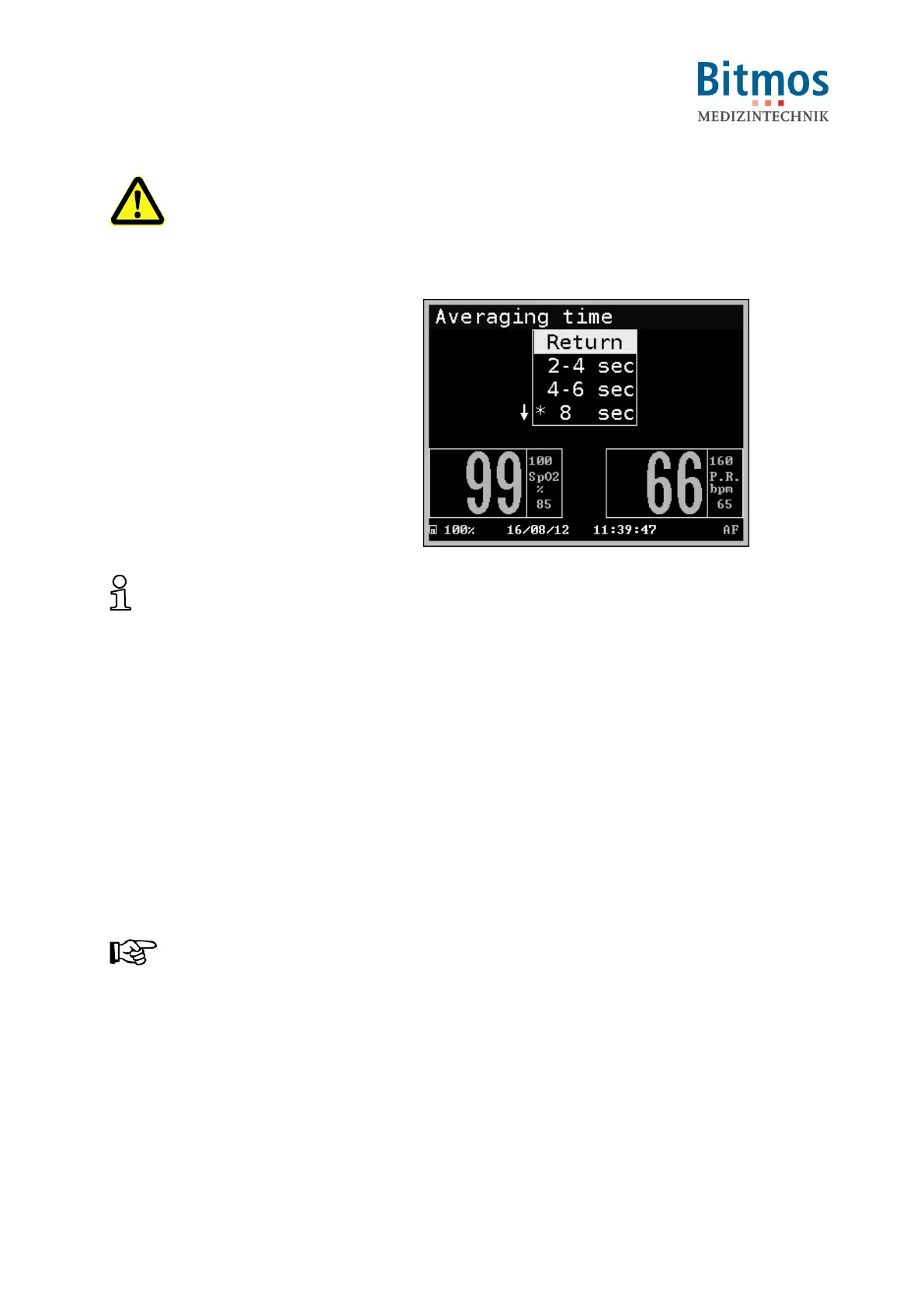
1. Starting from the main menu, call:
Configuration Signal
process Averaging time
2. Set the averaging time between 2-4
and 16 sec.
3. Confirm this setting with RETURN.
Fig. 49: Averaging time
What is FastSat™?
FastSat™ permits the display of sudden oxygen saturation changes. In general these rapid
changes in oxygen saturation are handled by the signal distribution i.e. display. FastSat™
can be especially useful for incubations or for polysomnography, where a high level of
reliability in the saturation recognition process is desirable. FastSat™ is also able to stream
the oxygen saturation changes from breath to breath.
7.6.3.2 Perfusion Sensitivity (Algorithm mode)
The perfusion sensitivity can be set between Normal (Norm. perfus.), High (low
perfus.) and APOD (APOD):
– The normal Perfusion –Sensitivity has been optimized for continuous long-term monitoring.
Depending on signal quality the lower signal strength value lies between 0.5% and 0.02%.
– The higher Perfusion –Sensitivity (= lower perfusion) may only be used for supervised
clinical situations. This setting is dependent on the sensor alarms, since it is only activated
for signals smaller than 0.02%. The lower signal strength value lies at 0.02%.
NOTICE!
If the signal deteriorates below the configured signal strength value, the unit turns to Pulse-
Search-Mode.
– APOD is a suite of complex and powerful signal processing algorithms that carefully
analyze the incoming signal to determine if the pulse oximeter sensor is on or off the
patient. Adaptive Probe Off Detection (APOD) delivers enhanced protection against
erroneous pulse rate and arterial oxygen saturation readings when a sensor becomes
detached from the patient. By providing another sensitivity level, APOD directly addresses a
problem common to pulse oximetry and gives the clinician an unprecedented level of
control.


 To Next Page