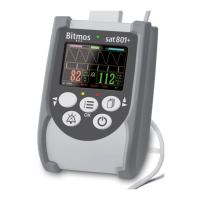
sat801+ Pulse Oximeter
Safety
9
– Pulse rate measurement is based on the optical detection of a peripheral flow pulse and
therefore may not detect certain arrhythmias. The pulse oximeter should not be used as a
replacement or substitute for ECG based arrhythmia analysis.
– If an alarm condition (other than the exceptions listed herein) occurs while the alarm tone
volume is set to off, the only alarm indications will be visual displays and symbols related to
the alarm condition.
– This device is to be operated by qualified personnel only. This manual, accessory directions
for use, all precautionary information, and specifications should be read before use.
– Do not use any extensions power cords or adapters of any type. The plug-in power supply
must be intact and undamaged.
– Explosion hazard. The pulse oximeter may not be used in a combustible atmosphere. This
can develop when working with flammable anesthetics, laughing gas, or other combustible
gases and liquids.
– The pulse oximeter may not be operated in a switchable power socket. Such a plug socket
is unsuitable for a secured power supply.
– Interfering Substances: Dyes, or any substance containing dyes, that change usual blood
pigmentation may cause erroneous readings. SpO2 is empirically calibrated to functional
arterial oxygen saturation in healthy adult volunteers with normal levels of
carboxyhemoglobin (COHb) and methemoglobin (MetHb). A pulse oximeter cannot
measure elevated levels of COHb or MetHb. Increases in either COHb or MetHb will affect
the accuracy of the SpO2 measurement.
– For increased COHb: COHb levels above normal tend to increase the level of SpO2. The
level of increase is approximately equal to the amount of COHb that is present.
NOTE:
High levels of COHb may occur with a seemingly normal SpO2. When elevated levels of
COHb are suspected, laboratory analysis (co-oximetry) of a blood sample should be
performed.
– Elevated levels of Methemoglobin (MetHb) will lead to inaccurate SpO2 measurements.
When elevated levels of MetHb are suspected, laboratory analysis (co-oximetry) of a blood
sample should be performed.
– Elevated levels of Carboxyhemoglobin (COHb) will lead to inaccurate SpO2measurements.
When elevated levels of COHb are suspected, laboratory analysis (co-oximetry) of a blood
sample should be performed.
– Elevated levels of Total Bilirubin may lead to inaccurate SpO2 measurements.
– Severe anemia may cause erroneous SpO2 readings.
The presence of carboxyl (HbCO)-, methaemoglobin, (Hbmet) or diluted dyes
or substances containing dyes in the blood stream can influence the measurements and
can lead incorrectly to higher values.
– When using the pulse oximeter near equipment, which emits strong electro magnetic
signals, (e.g. mobile telephones, monitors, etc.) the functionality can be reduced.
– Do not use the sat801+ or sensors during magnetic resonance imaging (MRI) scanning.
Induced current could potentially cause burns. The sat801+ may affect the MRI image and
the MRI device may affect the accuracy of the Pulse Oximetry parameters and
measurements.
2.2 User responsibility
This user manual information must be kept within direct proximity of the unit and must be
available to those using the equipment at any time.


 To Next Page