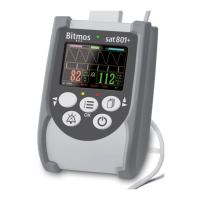
sat801+ Pulse Oximeter
Alarms
52
8 Alarms
8.1 In General
As a monitoring system the unit has been equipped audio and optical signals for a multiple
number of alarm situations. Alarms are activated:
– When deviations from pre-set value limits occur
– In problem situations during technical monitoring
– Internal unit malfunctions
WARNING! Danger with incorrectly entered alarm limits!
Before each use test the unit on a patient to see if the configured alarm limits are
patient appropriate.
If the accuracy of the displayed values is questioned, check the patient’s vital
parameters first using a different method. Then check the functionality of the unit.
Inaccurate measurements can be caused by:
– Incorrect sensor connection or incorrectly selected Masimo-sensor
– A significant inclusion of dysfunctional hemoglobin (e.g. (carboxyhemoglobin or
methemoglobin)
– Intravascular dyes such as indocyanine green or methylene blue are present in the blood
stream
– Excessive light intrusion, such as operating lamps (especially xenon light sources), bilirubin
lamps, fluorescent lights, infrared heat sources or direct sun light (excessive light intrusion
can be avoided with a dark or transparent sensor shade)
– Excessive movement of the patient
– Venous blood pulse
– Connection of the sensors is to a body part already connected to a blood pressure cup, an
arterial catheter, or an intravenous line.
Loss of pulse signal can occur under the following conditions:
– The sensor is attached too tightly.
– There is excessive illumination from light sources such as operation or bilirubin lamps or
sunlight.
– An inflated blood pressure cuff is attached on the same extremity as the sensor.
– The patient suffers from low blood pressure, serious vascular constriction and/or
anemia or hypothermia.
– There is an arterial occlusion proximal to the sensor.
– The patient suffered from shock or heart failure.
– The fingernail is polished.
8.2 Alarm filter
CAUTION!
Changing the alarm filter settings is a serious intervention in the device functions
and must never be done without first consulting the doctor in charge of the
treatment!


 To Next Page