Need help?
Do you have a question about the Bitmos sat801+ and is the answer not in the manual?
Details on safe and appropriate handling and adherence to safety notices.
Explanation of symbols used for technical safety notices and cautionary advice.
Information regarding liability limitations and warranty terms for the device.
Details on copyright laws and patent rights for the manual and device.
Instructions for the correct disposal of packaging, batteries, and the unit.
Describes the device's purpose for continuous monitoring of oxygen saturation and pulse frequency.
Defines user obligations regarding manual accessibility, proper use, and maintenance.
Details potential risks, including health risks, electrical hazards, and battery dangers.
Specifies that the unit should only be operated by trained specialists and instructed users.
Provides contact information for Bitmos GmbH for support and inquiries.
Lists physical specifications, power supply, operating temperature, and classification of the unit.
Outlines the pre-configured settings for alarm limits, averaging time, and mode upon initial use.
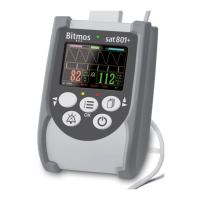
Identifies and describes the unit's display elements and physical control buttons.
Details the available connection ports on the unit, including USB and patient cable.
Explains the various information displayed on the unit's screen and their meanings.
Illustrates and defines the meaning of symbols and pictograms found on the unit.
Provides information and cautions regarding the use of the unit's USB interface.
Guidelines for checking deliveries for completeness and potential shipping damage.
Recommendations for using original packaging to minimize damage during transport.
Specifies the recommended conditions for storing the unit to maintain its integrity.
Details suitable environmental conditions for the unit's operation, including humidity and flooring.
Steps to take before the first use, including familiarization and testing.
Information on how the unit is powered, including mains connection and battery.
Instructions for connecting the unit to an electrical power source using the adapter.
Details on using the unit with its internal battery, including expected duration.
Procedures for switching between mains power and battery operation.
Steps to connect the unit to mains power when it is in battery operation.
Guidance on connecting external components like patient cables and sensors.
Instructions for safely disconnecting Masimo sensors from the patient cable.
Steps for detaching the patient cable from the main unit.
Advice on positioning the unit for optimal patient mobility and safety.
Important warnings and guidelines for the correct application of Masimo sensors.
A guide to choosing the appropriate Masimo sensor based on patient age, weight, and re-usability.
Overview of unit control via display and buttons, and writing format used in the manual.
Explains how to navigate and interact with the unit's menu system.
Step-by-step instructions for powering on the pulse oximeter unit.
Process for safely powering down the pulse oximeter to avoid accidental shutdowns.
Covers setting and adjusting alarm limits for SpO2 and pulse rate.
Instructions for configuring the alarm filter to reduce irrelevant alarm conditions.
Allows adjustment of screen options, language, and access permissions.
Overview of the unit's alarm system, including audio and optical signals.
Explains how to set an alarm filter to reduce irrelevant alarm conditions.
Defines the four categories of alarms: High, Mid-level, Low-priority, and their implications.
Details high priority alarms requiring immediate intervention to prevent patient harm.
Covers mid-level alarms indicating technical problems requiring quick user intervention.
Details low-level priority alarms requiring heightened user attention.
Explains how alarms of different priorities are handled when occurring simultaneously.
Provides information on the current monitoring situation through status messages.
Information on how the device stores and displays alarm events.
Displays a comprehensive list of all alarm events, including vital and technical alarms.
Provides detailed information for specific alarm entries in the alarm lists.
Offers a graphical display of recorded monitoring data over time.
Explains how to select time scales and display modes for the trend data.
Instructions for exporting stored data to a micro SD card for analysis.
Instructions for exporting stored data to a micro SD card for analysis.
Procedure for transferring data from the unit to a computer via USB.
Procedures for cleaning the unit, Masimo sensors, and patient cables.
Steps for cleaning the patient cables using a cloth and isopropyl alcohol.
Information on required maintenance, including yearly checks and user alarm function tests.
Lists available original accessories and replacement parts for the unit.
Explains the function of averaging time and its effect on signal display and alarm detection.
Illustrates the components of alarm system delay, including processing and communication times.
 General
| Brand | Bitmos |
|---|---|
| Model | sat801+ |
| Category | Medical Equipment |
| Language | English |

 To Next Page