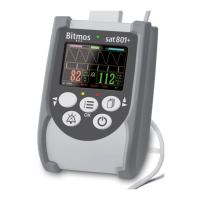
sat801+ Pulse Oximeter
Technical data
12
3 Technical data
3.1 Unit data
Feature Value
Unit dimensions (L x W x H) 128 x 85 x 46 mm
Weight, including batteries
230 g
External power supply 240 V ~50 Hz
5 V DC 1 A
Internal power supply LiIonMn 2 x 3.6 V / 2250 mAh (each)
Maximum service life with battery
operation
22 hours guaranteed (fully charged)
Operating temperature +5° to + 40°C
Storage temperature -25° to + 70°C
Classification in accordance with
MDD (Medical Device Directive)
ll b
Characteristic data SpO
2
Pulse
Display range 1-100 % 25-240 1/min
Accuracy
– without Movement, Adults ,
Children and Newborns
25-240 1/min+/- 3 digits
Accuracy
– with Movement, Adults , Children
and Newborns
25-240 1/min+/- 5 digits
Accuracy
– without Movement, Adults and
Children
70-100 %+/- 2 digits
0-69% not specified
Accuracy
– without Movement, Newborns
70-100 %+/- 3 digits
0-69% not specified
Accuracy
– under Movement, Adults ,
Children and Newborns
70-100 %+/- 3 digits
0-69% not specified
Resolution 1 % 1 1/min
Data update interval 1 Hz 1 Hz
The Masimo SET Technology with LNOP Adt sensors has been validated for no motion accuracy in human blood studies on healthy
adult volunteers in induced hypoxia studies in the range of 70-100% SpO2 against a laboratory cooximeter and ECG monitor. This
variation equals plus or minus one standard deviation which encompasses 68% of the population.
The Masimo SET Technology with LNOP Adt sensors has been validated for motion accuracy in human blood studies on healthy
adult volunteers in induced hypoxia studies while performing rubbing and tapping motions, at 2 to 4 Hz at an amplitude of I to 2 cm
and a non-repetitive motion between I to 5 Hz at an amplitude of 2 to 3 cm in induced hypoxia studies in the range of 70-100% SpO2
against a laboratory co-oximeter and ECG monitor. This variation equals plus or minus one standard deviation which encompasses
68% of the population.
The Masimo SET Technology with LNOP Neo and Neo Pt sensors has been validated for neonatal motion accuracy in human blood
studies on neonates while moving the neonate's foot at 2 to 4 Hz at an amplitude of 1 to 2 cm against a laboratory co-oximeter and
ECG monitor. This variation equals plus or minus one standard deviation which encompasses 68% of the population.


 To Next Page