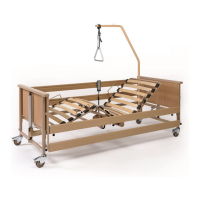
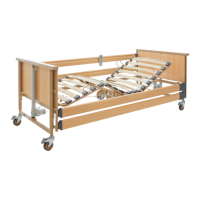
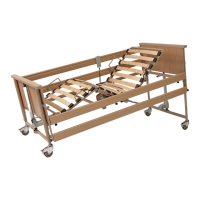
Instruction Manual for Lenus Care Bed
Page 32
4.2 MOVING AND BRAKING THE BED
The bed is equipped with four lockable castors, which can be braked in pairs (at the
head end and foot end of the bed) (10). The bed can be moved within the room even
when the bed is occupied.
• A bed that is occupied by someone should be moved around only inside
the room. Always avoid moving the bed over long distances along
corridors and across thresholds.
• Each time before moving the bed, ensure that:
o The mains cable cannot be stretched, driven over or damaged in any
other way.
o The power adapter is always hooked onto the safety side bars using
the mains cable holder and the cable does not trail on the floor.
o All cables, tubes or leads belonging to any accessory devices that are
attached to the bed are safely secured and cannot be damaged.
Otherwise the mains cable could sustain damage as a result of being
torn off, crushed or driven over. Such damage could lead to electrical
hazards and malfunctions.
• Braking: In order to brake the bed, always brake all four castors. This is
particularly important if the bed and resident are left unsupervised or the
bed is on a sloping floor (e.g. on a ramp). A safe and secure bed position
must always be ensured!
- Exception: When the bed is to be adjusted to the Trendelenburg or
reverse Trendelenburg position
, either the head-end or foot-end castors must be unbraked. This
allows the bed to compensate for the movement of the two lift
motors without the castors causing damage to the floor (castor
tracks).


 To Next Page