Risk of injury
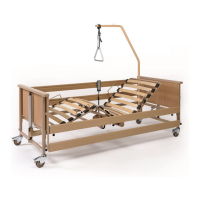
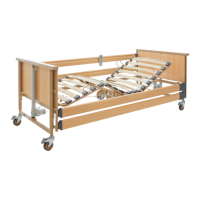
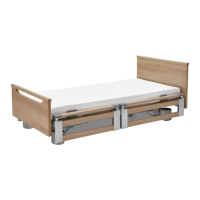
• Efficient and safe operation combined with maximum protection of residents can
only be guaranteed if original Burmeier accessories are used that are designed
for the relevant model of bed.
• In addition to the information given in this instruction manual, please also refer in
this respect to the separate special instruction manuals supplied with certain
accessories
• Make sure that the arrangement of accessories does not produce any crush or
shearing zones for the resident when the backrest and leg rest are adjusted. If
this cannot be guaranteed, the user must safely prevent the resident from
adjusting the backrest and leg rest.
To do this, place the handset out of reach (e.g. at the foot end of the bed) or lock
the handset adjustment options.
Preventing damage to property
In order to minimise any potential damage to property, please observe the following
general information on selecting and attaching accessories:
• Attach accessories only for as long as they are required and only at the
positions intended for them, taking care to avoid damaging the surfaces of the
bed and accessories.
• Avoid chafing, for example, or the unprotected attachment of metal clamps to
coated or varnished surfaces.
• Please note when moving the bed that attached accessories may extend
beyond the height, width or length of the bed and so may collide more easily
with door frames, corners of walls and other obstructions
• In the case of very long accessories such as patient lifting poles, infusion poles,
extensions, mobilisation aids etc., avoid applying high lateral forces to these,
such as by manoeuvring the bed using the infusion pole. This will prevent any
overloading of the fixing points.
Mattress requirements
Basic dimensions:
Length x width 200 x 90 cm (option: 200 x 100 cm)
Thickness/height max. 19 cm, for further details see chapter 4.6
Foam density at least 40 kg/m
3
Compression hardness at least 4.5 kPa
Applicable standards: DIN 13014
DIN 597 Part 1 and 2


 To Next Page