38 Chapter 6 Acquiring a 3D Model for Restoration
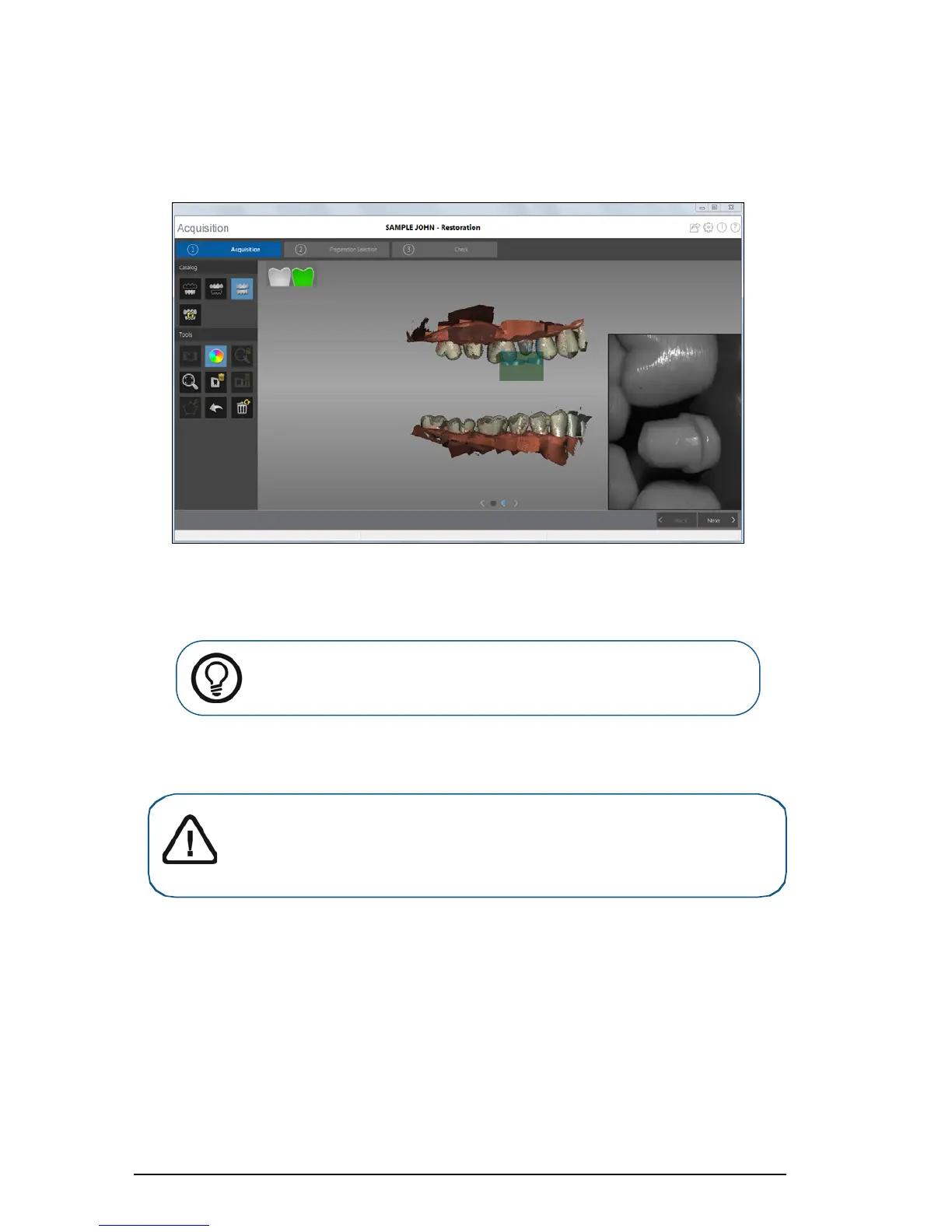
Half of a dot (only one arch, upper or lower) indicates a partial buccal bite. The example below
shows that one complete buccal bite image and one-half of a buccal bite image have been
acquired. Note the green box on the teeth on the upper jaw. To complete the bite, acquire the teeth
on the opposing jaw, directly opposite of the green box.
To complete a partial buccal bite image, move the CS 3500 slightly more gingival, toward the
missing arch, and ensure that there is at least a 30% overlap between the second buccal bite
acquisition and the previous one.
Once both arches are displayed in the Acquisition interface, the bite image is successful, and you
can acquire additional bite images, which will increase the accuracy of the bite.
4 Acquire at least two more buccal bite images, one on either side of the preparation area. You can
take up to six bite images for a full arch.
5 Once the bite has been registered, rotate the model and zoom the view to ensure that the bite is
accurate and that there are no areas where the bite is mismatched. Click a dot to view the bite for
that acquisition.
Tip: If you need to acquire a second buccal bite image because an
opposing arch is missing, always move toward the opposing arch with the
CS 3500.
Important: For a partial arch, you should acquire at least three buccal bite
images—one on the preparation, one mesial to the preparation, and one distal
to the preparation. For a full arch, you should acquire at least four buccal bite
images—one on each side of the mouth at the molars, and one on each side of
the mouth at the canines.



 To Next Page