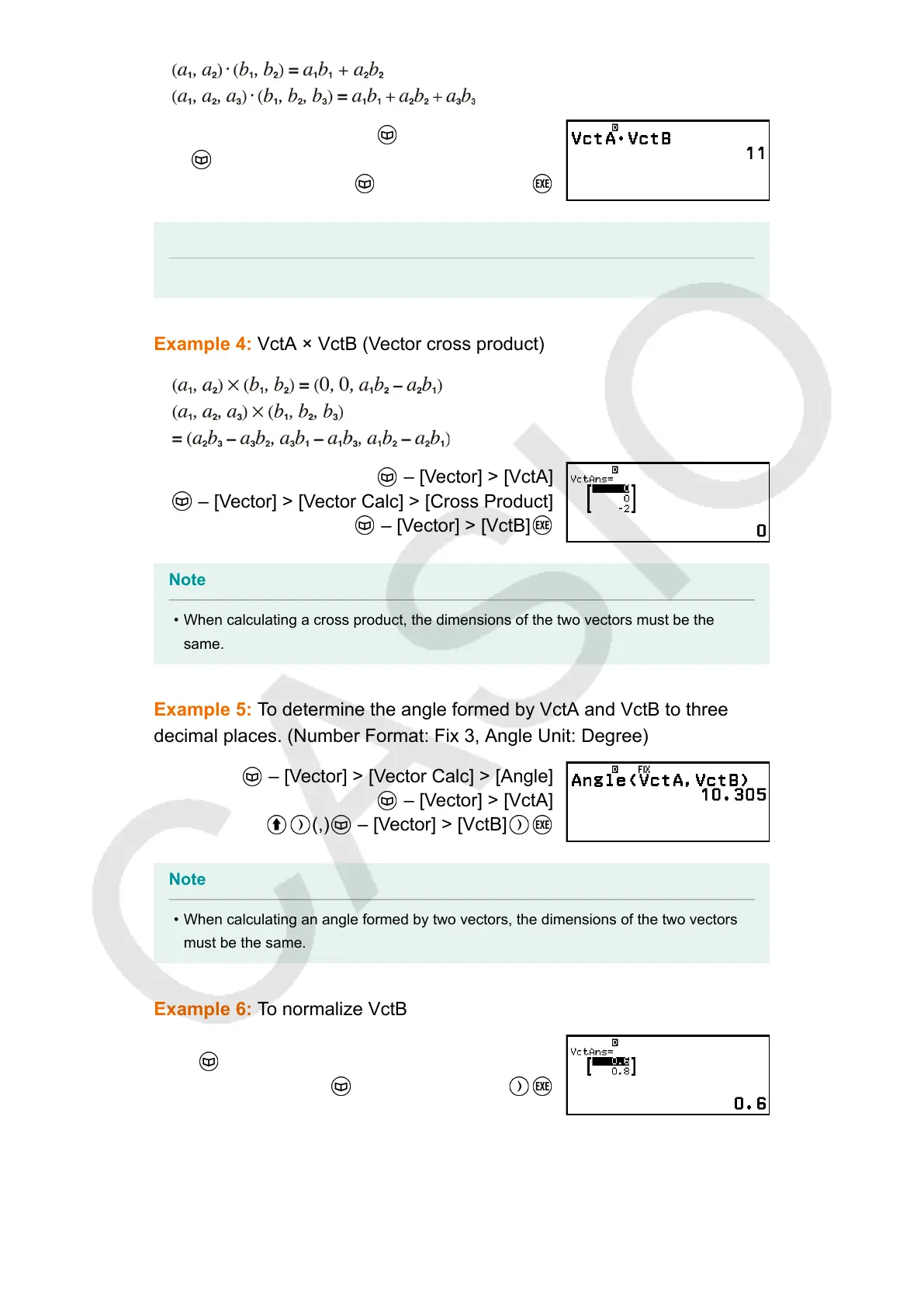
– [Vector] > [VctA]
– [Vector] > [Vector Calc] > [Dot Product]
– [Vector] > [VctB]
Note
• When calculating a dot product, the dimensions of the two vectors must be the same.
Example 4: VctA × VctB (Vector cross product)
– [Vector] > [VctA]
– [Vector] > [Vector Calc] > [Cross Product]
– [Vector] > [VctB]
Note
•
When calculating a cross product, the dimensions of the two vectors must be the
same.
Example 5: To determine the angle formed by VctA and VctB to three
decimal places. (Number Format: Fix 3, Angle Unit: Degree)
– [Vector] > [Vector Calc] > [Angle]
– [Vector] > [VctA]
(,) – [Vector] > [VctB]
Note
• When calculating an angle formed by two vectors, the dimensions of the two vectors
must be the same.
Example 6: To normalize VctB
– [Vector] > [Vector Calc] > [Unit Vector]
– [Vector] > [VctB]
Example 7: To obtain the absolute values of VctC
127



 To Next Page