10. APPENDICES
10.1. Warning flags
In the followings we summarize the warning flags and give an explanation of their possible
cause and a few hints to overcome the problem:
Uppercase letters refer to WBC or HGB problems:
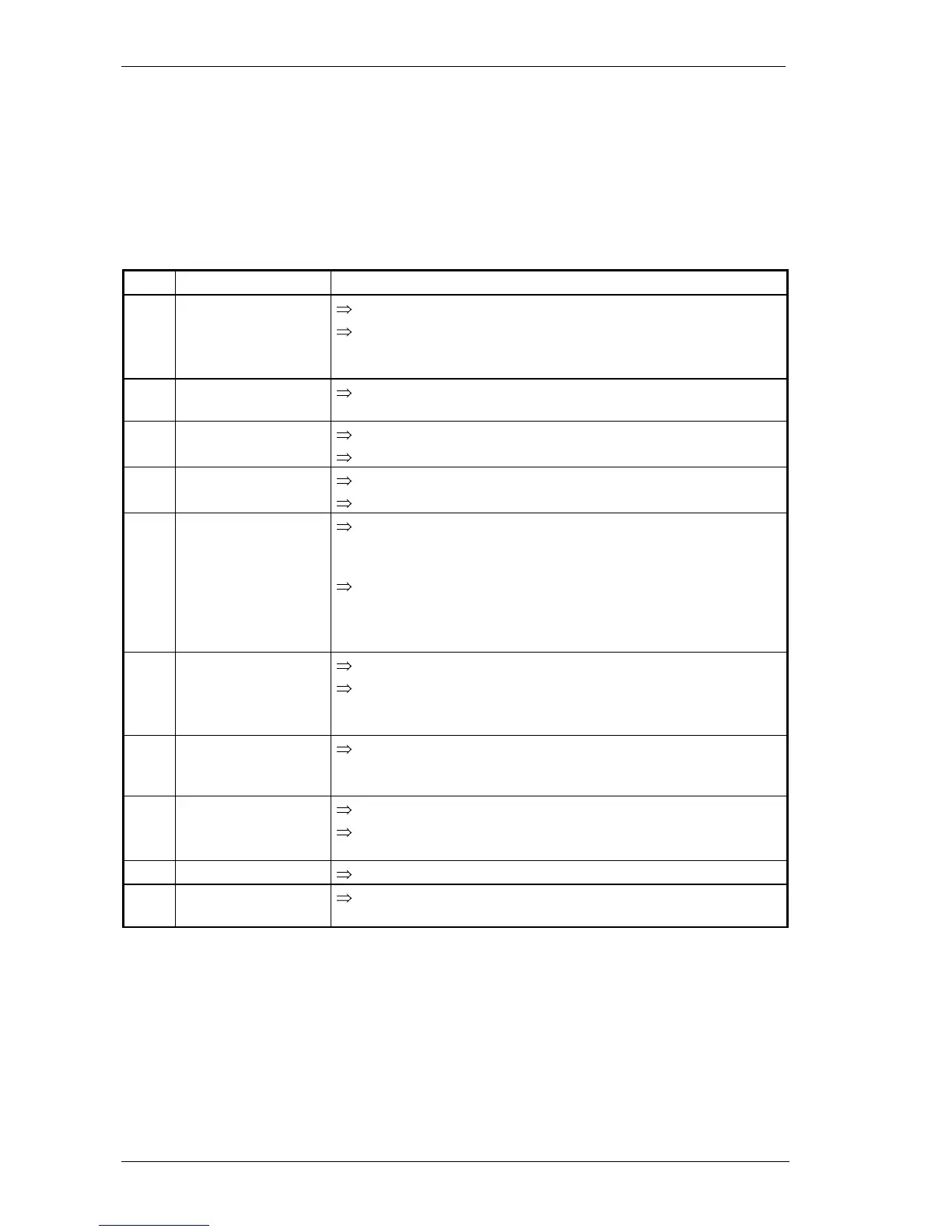
WBC three part
warning or WBC
three part diff.
unsuccessful
Repeat the measurement. Possibly lyse problem.
Check the discriminators in the WBC histogram. If the
discriminators are in the proper place (the populations can
be separated by eye) then the results can be accepted.
Possibly lyse problem, but in some pathological samples
(too high lymphocytes), it can be happened.
HGB blank is high,
or no HGB blank
Repeat the blank measurement and accept it.
Possibly lyse or diluent problem.
WBC blank is high,
or no WBC blank
Repeat the blank measurement and accept it.
Possibly lyse or diluent problem.
Check the 1. RBC-LYM discriminator. If it is in the minimum
point (or close to it), accept the results. Otherwise repeat
the measurement.
If the retried action makes very similar results and the
discriminator is in a wrong place then the MID and GRA
results are OK, but the WBC and LYM results can be
higher because of the RBCs.
Too many RBC cut
from WBC
Repeat the measurement. Possibly lyse problem.
If the WBC measuring time is too high (more than 8 sec.) it
could be aperture clogging. In that case perform cleaning
and repeat the measurement.
WBC coincidence is
too high. Linearity
error.
The results are out of the linearity range. Make a dilution
with an external dilutor with a pre-defined dilution range. Do
not forget to correct the results with the defined factor.
Perform cleaning, redo measurement (aperture clogging).
If it is a general problem, please call your Service
Personnel.
The same action as in case of the D warning flag.
Aperture clogging. The same action as in case of the D
warning flag.
Table 9. Summary of warning flags related to WBC/HGB



 To Next Page