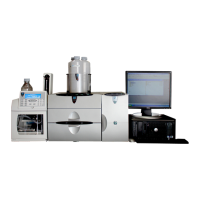
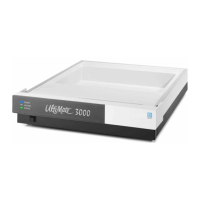
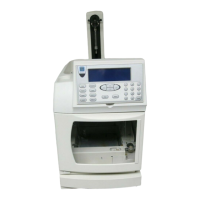
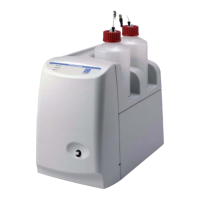
UltiMate 3000 RSLCnano – Standard Applications
11
Before the parts of the application kit are installed, the UltiMate 3000 RSLCnano system has
to be prepared and primed. To prepare the system, the following steps are required. For more
details, see the operating instructions for the respective module.
To control the module, Thermo Scientific Dionex Chromeleon 6.80 SR8 (or later) or
DCMSLink version 2.8 (or later) and appropriate license are required.
Prepare electrical and USB connections, power up modules, and then prepare server
configuration.
Prepare solvents and install them according to the application.
- NC pump channels A and B
- Loading pump channels A, B, and C (10-50% isopropanol in water for unused
channels)
- Rear seal wash solvent (~10% isopropanol in water)
- Autosampler wash solvent (~10% isopropanol 0.1% FA in water).
Use the PEEK solvent inlet filter frits in both, the NC pump and loading pump
solvent lines.
Tip
Degassing of the loading pump solvents is required when the loading pump is
used for gradient formation or the flow rate is above 20 µL/min.
Purge both blocks of the NC pump (min 30 min.), while assisting with a syringe until
liquid exits the purge lines. Purge all channels of the loading pump (minimum 10 min).
Tip
Make sure that the purge screws of the NC_Pump are entirely opened.
Purge flow meter for 30 min.
Tip
The purge time with a nano flow selector is 30 minutes. For capillary and micro
flow selectors purge times may be shorter. Please refer to the NCS-3500RS or
NCP-3200RS manual for details.
Perform pressure sensor offset calibration, using Chromeleon Diagnostics. To do so, open
the More options panel of the NC_Pump and click the related button.
Perform viscosity calibration using Chromeleon Diagnostics or select default viscosities
from the available viscosity list.
Tip
To see the solvent list for which default viscosities are available, use the
Commands dialog (F8) and scroll to Pump module NC_Pump
%A_Viscosity (%B_Viscosity).
Prepare all fluidics using the provided nanoViper connection tubing.
Tip
Do not overtighten the fingertight connection!



 To Next Page