WARNING: WITH TOOL IN PLACE, PRESSURE WILL
BUILD UP FAST. EXCESSIVE PRESSURE BUILT UP,
BY CONTINUOUS ENGINE OPERATION, MUST BE
RELEASED TO A SAFE PRESSURE POINT. NEVER
PERMIT PRESSURE TO EXCEED 138 kPa (20 psi).
If the needle on the dial does not fluctuate, raise
the engine rpm a few times. If an abnormal amount
of coolant or steam emits from the tailpipe, it may
indicate a coolant leak caused by a faulty head gas-
ket, cracked engine block, or cracked cylinder head.
There may be internal leaks that can be deter-
mined by removing the oil dipstick. If water globules
appear intermixed with the oil it will indicate an
internal leak in the engine. If there is an internal
leak, the engine must be disassembled for repair.
COOLING SYSTEM AERATION
Low coolant level in a cross flow radiator will
equalize in both tanks with engine off. With engine
running at operating temperature, the high pressure
inlet tank runs full and the low pressure outlet tank
drops, resulting in cooling system aeration. Aeration
may create the following conditions:
• High reading shown on the temperature gauge.
• Inadequate coolant flow through the heater.
• Engine combustion leaks into the coolant can
also cause the same problems.
COOLING SYSTEM DEAERATION
Air is removed from the system as it gathers in the
coolant deaeration pressure bottle. Air is released
into the atmosphere through the pressure valve
located in the pressure cap when pressure reaches
110 - 124 kPa (16 - 18 psi). The air is replaced with
coolant from the coolant recovery bottle.
STANDARD PROCEDURE
ROUTINE COOLANT LEVEL CHECK
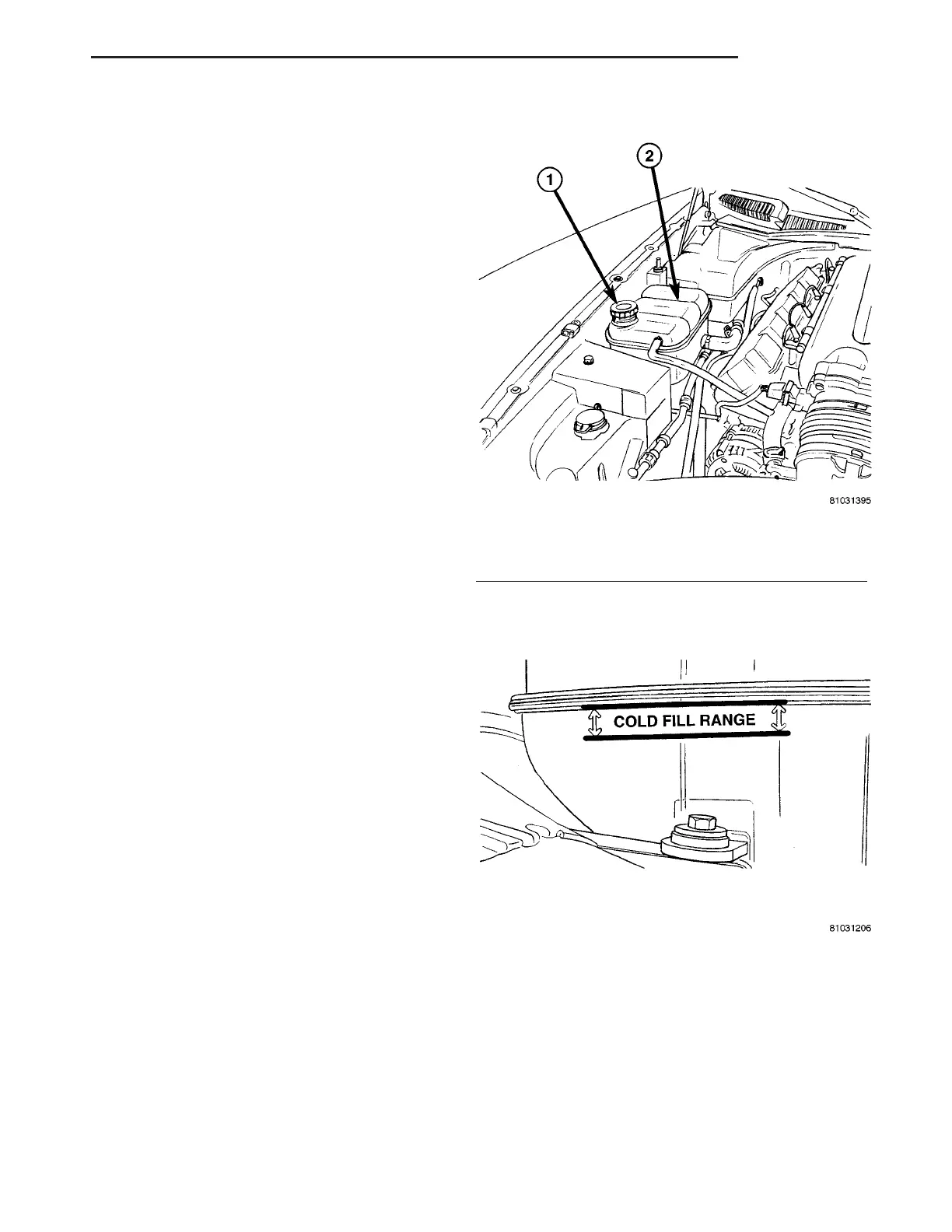
Do not remove pressure bottle cap for routine
coolant level inspections.
The coolant pressure bottle provides a quick visual
method for determining the coolant level without
removing the pressure cap (Fig. 2).
With the engine cold, the coolant level in the cool-
ant pressure bottle should be in the COLD FILL
RANGE (Fig. 3).
With the engine warmed up, the coolant level
should be above the COLD FILL RANGE.
Fig. 2 Coolant Pressure Bottle and Cap
1 - PRESSURE CAP
2 - COOLANT PRESSURE BOTTLE
Fig. 3 Cold Fill Range
ZB ENGINE 7 - 11
ENGINE (Continued)





 To Next Page