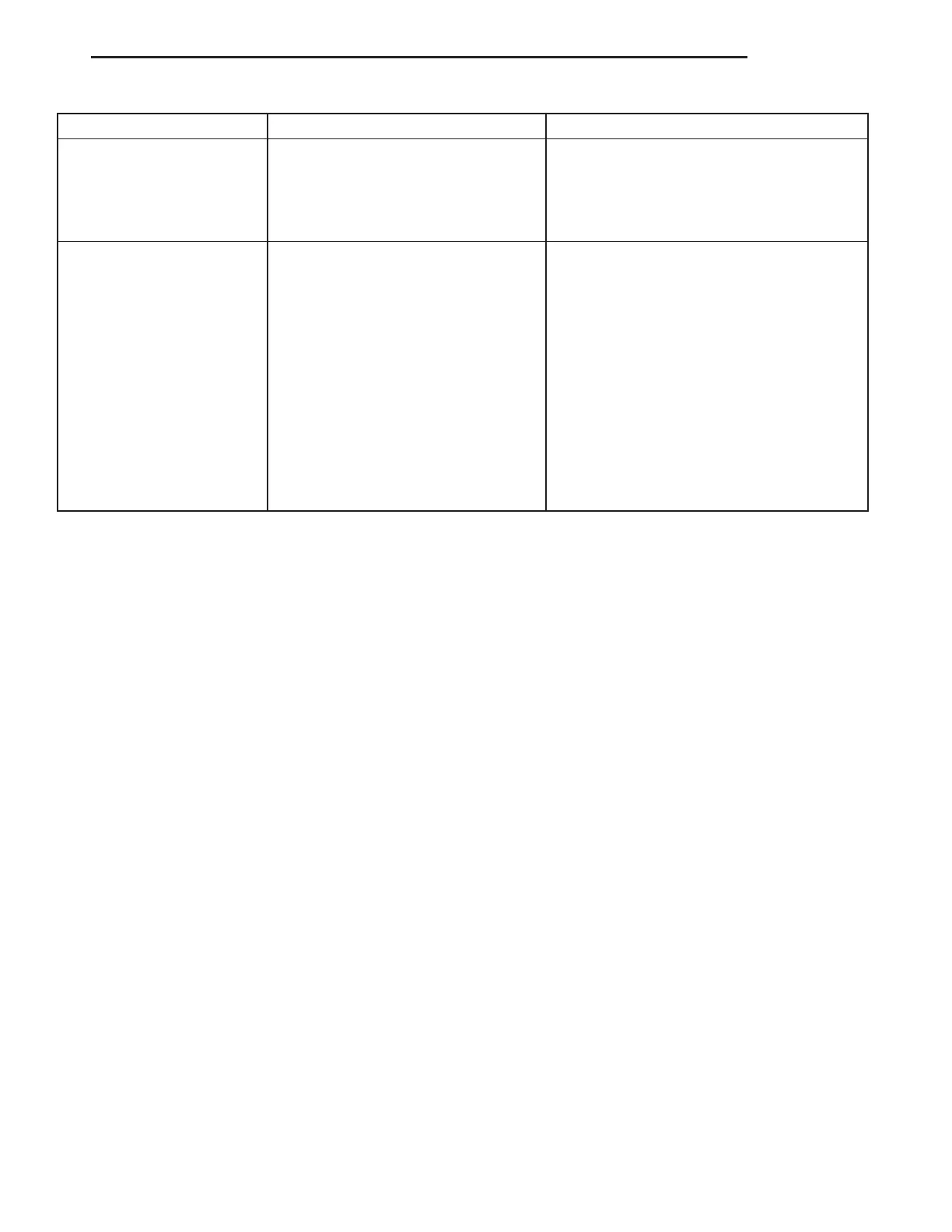
CONDITION POSSIBLE CAUSES CORRECTION
OIL LEAKS 1. Misaligned or deteriorated gas-
kets.
1. Replace gaskets.
2. Loose fastener, broken or porous
component.
2. Tighten, repair or replace component.
EXCESSIVE OIL CON-
SUMPTION OR SPARK
PLUGS OIL FOULED
1. PCV system malfunction. 1. Check and repair PCV system as nec-
essary.
2. Defective valve stem seal(s). 2. Repair or replace seal(s).
3. Worn or broken piston rings. 3. Hone cylinder bores. Install new rings.
4. Scuffed pistons/cylinder walls. 4. Hone cylinder bores and replace pistons
as necessary.
5. Carbon in oil control ring groove. 5. Remove rings and de-carbon piston.
6. Worn valve guides. 6. Ream and install new valves with over-
size stems.
7. Piston rings fitted too tightly in
grooves.
7. Remove piston rings. Check ring end
gap and side clearance. Replace as nec-
essary.
CYLINDER COMPRESSION PRESSURE TEST
The results of a cylinder compression pressure test
can be utilized to diagnose several engine malfunc-
tions.
Ensure the battery is completely charged and the
engine starter motor is in good operating condition.
Otherwise the indicated compression pressures may
not be valid for diagnosis purposes.
(1) Check engine oil level and add oil if necessary.
(2) Drive the vehicle until engine reaches normal
operating temperature. Select a route free from traf-
fic and other forms of congestion, observe all traffic
laws, and accelerate through the gears several times
briskly.
(3) Remove the Auto Shut Down (ASD) relay from
the Power Distribution Center (PDC).
(4) Disconnect ignition cables from spark plugs.
(5) Remove all spark plugs from engine. As spark
plugs are being removed, check electrodes for abnor-
mal firing indicators fouled, hot, oily, etc. Record cyl-
inder number of spark plug for future reference.
(6) Be sure throttle blade is fully open during the
compression check.
(7) Insert compression gauge adaptor Special Tool
8116 or the equivalent, into the No. 1 spark plug hole
in cylinder head. Connect the 0-500 psi (Blue) pres-
sure transducer (Special Tool CH7059) with cable
adaptors to the scan tool. For Special Tool identifica-
tion, (Refer to 9 - ENGINE - SPECIAL TOOLS).
(8) Crank engine until maximum pressure is
reached on gauge. Record this pressure as No. 1 cyl-
inder pressure.
(9) Repeat the previous step for all remaining cyl-
inders.
(10) Compression should not be less than 689 kPa
(100 psi) and not vary more than 25 percent from cyl-
inder to cylinder.
(11) If one or more cylinders have abnormally low
compression pressures, repeat the compression test.
(12) If the same cylinder or cylinders repeat an
abnormally low reading on the second compression
test, it could indicate the existence of a problem in
the cylinder in question. The recommended com-
pression pressures are to be used only as a
guide to diagnosing engine problems. An engine
should not be disassembled to determine the
cause of low compression unless some malfunc-
tion is present.
CYLINDER COMBUSTION PRESSURE LEAKAGE
TEST
The combustion pressure leakage test provides an
accurate means for determining engine condition.
Combustion pressure leakage testing will detect:
• Exhaust and intake valve leaks (improper seat-
ing).
• Leaks between adjacent cylinders or into water
jacket.
• Any causes for combustion/compression pressure
loss.
WARNING: DO NOT REMOVE THE COOLING SYS-
TEM PRESSURE CAP WITH THE SYSTEM HOT AND
UNDER PRESSURE BECAUSE SERIOUS BURNS
FROM COOLANT CAN OCCUR.
ZB ENGINE 9 - 7
ENGINE - 8.3L (Continued)









 To Next Page