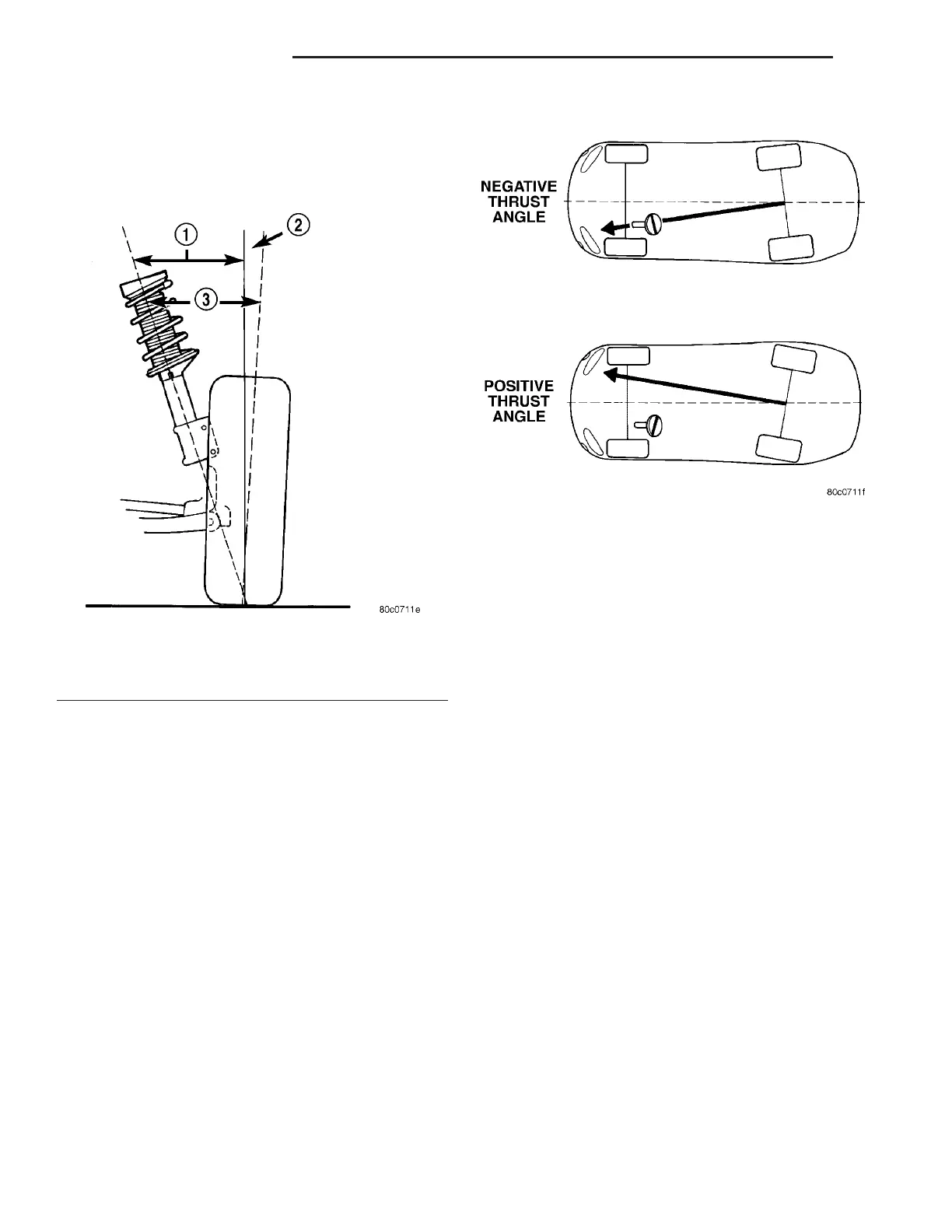
center of the upper ball joint (or strut) and the lower
ball joint (Fig. 5). S.A.I. is built into the vehicle and
is not an adjustable angle. If S.A.I. is not within
specifications, a bent or damaged suspension compo-
nent may be the cause.
INCLUDED ANGLE (I.A.)
Included angle is the sum of the S.A.I. angle plus
or minus the camber angle, depending on whether or
not the wheel has positive or negative camber (Fig.
5). If camber is positive, add the camber angle to the
S.A.I angle. If camber is negative, subtract the cam-
ber angle from the S.A.I. angle. Included angle is not
adjustable, but can be used to diagnose a frame mis-
alignment or bent suspension component (spindle,
strut).
THRUST ANGLE
Thrust angle is the averaged direction the rear
wheels are pointing in relation to the vehicle’s center
line (Fig. 6). The presence of negative or positive
thrust angle causes the rear tires to track improperly
to the left or right of the front tires (dog tracking).
• Negative thrust angle means the rear tires are
tracking to the left of the front tires.
• Positive thrust angle means the rear tires are
tracking to the right of the front tires.
Improper tracking can cause undue tire wear, a
lead or pull and a crooked steering wheel. Excessive
thrust angle can usually be corrected by adjusting
the rear wheel toe so that each wheel has 1/2 of the
total toe measurement.
CURB HEIGHT
There are two different vehicle suspension heights
measured on this vehicle. They are Curb Height and
Design Height. Curb height is the vehicle’s height
when:
• it has a full tank of fuel;
• all fluids are filled to their proper levels; and
• no passengers or additional weight have been
added to the vehicle.
For information on design height, (Refer to 2 -
SUSPENSION/WHEEL ALIGNMENT - DESCRIP-
TION - DESIGN HEIGHT).
DESIGN HEIGHT
There are two different vehicle suspension heights
measured on this vehicle. They are Curb Height and
Design Height. For information on curb height,
(Refer to 2 - SUSPENSION/WHEEL ALIGNMENT -
DESCRIPTION - CURB HEIGHT).
Generally speaking, design height is the same as
curb, except for the addition of passengers loaded
into the driver and passenger seats. In other words,
design height of this vehicle is somewhat lower than
curb height.
The vehicle is set to design height during factory
production. At this height all rubber bushing-
mounted components of the vehicle’s suspension sys-
tem are tightened and torqued to specification.
Fig. 5 S.A.I. and I.A.
1 - S.A.I.
2 - CAMBER
3 - I.A.
Fig. 6 Thrust Angle
2 - 58 WHEEL ALIGNMENT ZB
WHEEL ALIGNMENT (Continued)





 To Next Page