(6) Verify that the module has been programmed
with the identification code of all four of the tire
pressure sensor/transmitters using the DRBIIIt scan
tool. Also check the tire pressure value from each tire
pressure sensor/transmitter. If these are present in
the receivers memory the receiver has been correctly
programmed.
(7) Road test the vehicle to verify the proper func-
tion of the tire pressure monitoring system.
SENSOR - TPM
DESCRIPTION
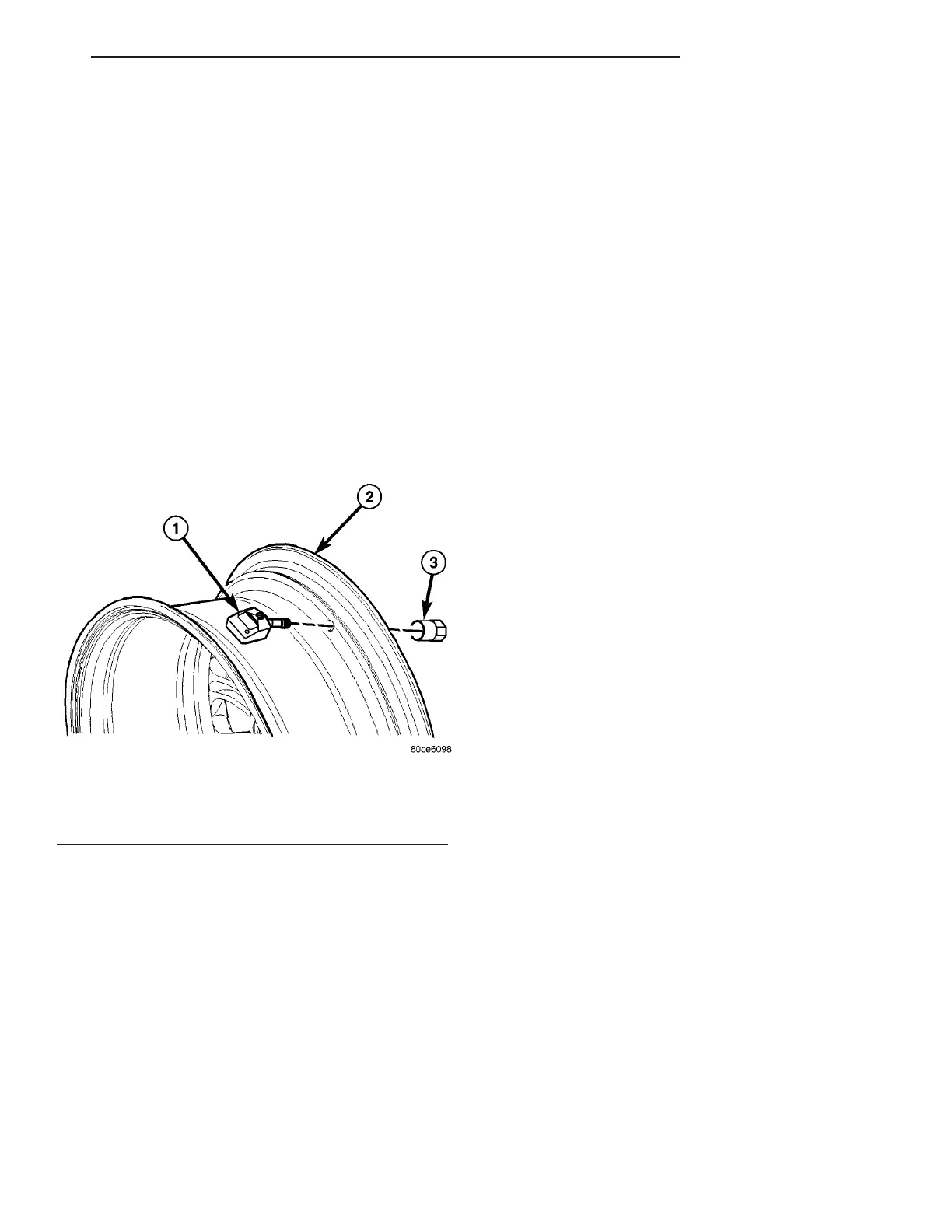
A tire pressure sensor/transmitter is installed in
each wheel of this vehicle as part of the tire pressure
monitoring system (Fig. 14). A special valve stem
incorporated into each tire pressure sensor/transmit-
ter attaches it to the wheel.
VALVE STEM CORE AND CAP
On this vehicle, the valve stem is part of the tire
pressure sensor/transmitter and is used as its
antenna. If corrosion were to develop in the valve
stem, it would affect the ability of the tire pressure
sensor/transmitter to send the radio frequency signal
to the TPM module.
The valve stem used on this vehicle is made from
aluminum. Corrosion of aluminum will be caused by
putting a dissimilar metal in contact with it. To pre-
vent this type of corrosion from developing within the
valve stem, the core of the valve stem is made of a
compatible metal and is specially coated.
For this reason, a standard valve stem core must
never be installed in this valve stem. If the core of
the valve stem is removed when servicing the tire,
the original valve stem core must be reinstalled. If
the valve stem core needs to be replaced, it must be
replaced with an original equipment valve stem core.
The valve stem caps used on this vehicle are spe-
cially designed for their use on the valve stem of the
tire pressure sensor/transmitter. Each valve stem cap
has an O-ring in the upper end of the valve stem cap
to provide a positive seal at the end of the valve
stem. This keeps dirt contamination and corrosion
out of the valve stem caused by moisture. As listed
earlier, these conditions can affect the ability of the
tire pressure transmitter to send the radio frequency
signal to the TPM module.
CAUTION: Be sure that an original equipment valve
stem cap or a valve stem cap of the same sealing
capability is always used if the valve stem cap
requires replacement.
OPERATION
Each tire pressure sensor/transmitter serves three
functions:
• It is used as a valve stem to inflate and deflate
the tire.
• It periodically measures tire pressure.
• It transmits the tire pressure value to the TPM
module in the vehicle.
The system operates by monitoring a radio fre-
quency transmission from the sensor/transmitters
located in each wheel. When the vehicle reaches a
speed of approximately 32 km/h (20 mph), centrifugal
force created by the rotating wheels closes a roll
switch inside each sensor/transmitter, powering up
the circuitry. The sensor/transmitters will only send
out information while the vehicle is operating at
speeds above 32 km/h (20 mph). To facilitate trans-
mitting the radio signal to the TPM module, the tire
valve stems act as antennas for the tire pressure sen-
sor/transmitters.
Each tire pressure sensor/transmitter is powered
by an internal battery. The battery is not replaceable
separately. In the event of battery failure, the entire
tire pressure sensor at that wheel will require
replacement. To extend the life of the battery, the
sensor/transmitter is not activated until the vehicle
reaches a speed of approximately 32 km/h (20 mph)
as stated earlier. Each tire pressure sensor/transmit-
ter has a unique identity code. This allows the TPM
system to indicate to a technician, through diagnostic
trouble codes in the module, which tire of the vehicle
has lost air pressure. This code is also used to iden-
tify to a technician which pressure sensor/transmit-
ter has set a diagnostic trouble code. For this reason,
if a tire pressure sensor needs to be replaced, the
new sensor must be programmed to have its identity
code recognized by the receiver.
Fig. 14 Sensor Mounting To Wheel
1 - TIRE PRESSURE SENSOR
2 - WHEEL
3 - NUT
ZB TIRES/WHEELS 22 - 9
MODULE - TPM (Continued)















 To Next Page