THEORY OF OPERATION -SOFTWARE
Band
4
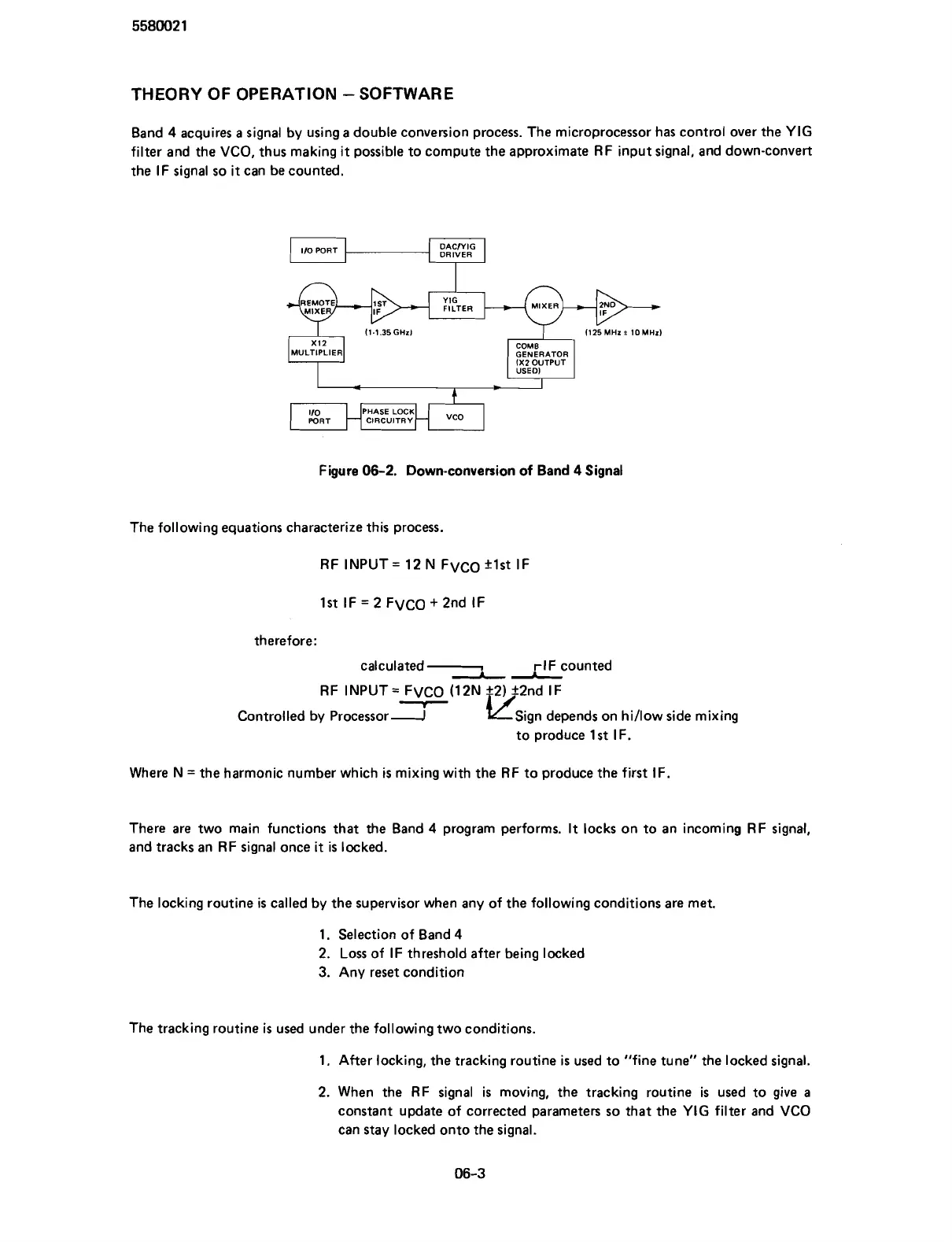
acquires a signal by using a double conversion process. The microprocessor has control over the YIG
filter and the VCO, thus making
it
possible to compute the approximate RF input signal, and down-convert
the IF signal so it can be counted.
YIG
FILTER
11.1.35
GHzI I125 MHz
t
10
MHz)
XI2
MULTIPLIER
COMB
GENERATOR
IX2 OUTPUT
USED1
Figure
06-2.
Down-conversion of Band
4
Signal
The following equations characterize this process.
therefore:
calculated
-
rl
F counted
41
RF INPUT
=
FvCO (12N +2) +2nd IF
7
Controlled by Processor- Kign depends on hihow side mixing
to produce 1st IF.
Where N
=
the harmonic number which
is
mixing with the RF to produce the first IF.
There are two main functions that the Band
4
program performs.
It
locks on to an incoming RF signal,
and tracks an RF signal once
it
is
locked.
The locking routine
is
called by the supervisor when any of the following conditions are met.
1. Selection of Band
4
2. Loss of IF threshold after being locked
3.
Any reset condition
The tracking routine
is
used under the following two conditions.
1. After locking, the tracking routine
is
used to "fine tune" the locked signal.
2. When the RF signal is moving, the tracking routine
is
used to give a
constant update of corrected parameters so that the YIG filter and VCO
can stay locked onto the signal.
Scans by ArtekMedia © 2007


 To Next Page