- 18 -
GENERAL DESCRIPTION
1 CONNECTIONS
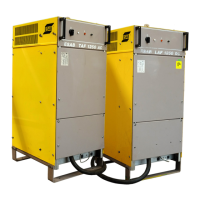
The DTG405 unit is powered by 400 V 3-phase AC via X1; the neutral conductor is not required.
For TIG welding, shielding gas is also needed and is supplied via a pressure reducer.
The welding-current sockets are designated in the circuit diagram as X2; X3 and X7. Usually, the
earth conductor is connected to X2, and the TIG torch is connected to X3.
X3 contains the gas connection. The "cold side" of the HF reactor is routed externally via X7. Pro-
vision is made there to connect an electrode holder. In electrode mode, no HF ignition pulses are
generated. During welding, however, no-load voltage or weld voltage is applied to the torch not in
use.
If welding is carried out with electrodes tied to the positive pole, the earth conductor should be
connected to X7, and the electrode conductor to X2.
Foot or hand remote regulators can be connected to the remote-regulator connector X5.
2 POWER ELECTRONICS ENERGY FLOW
The mains voltage is first routed to the mains switch Q1. When ON, the mains voltage is connect-
ed through to the power rectifier A3 via interference filter A15. Rectified mains voltage (+UZ and
-UZ) is applied to the output of A3. -UZ is connected direct to the link capacitors C1, C2, C3, C4
and the primary switches A4, A5, A11, A12. At unit POWER ON, the start-up contactor K1 is open.
Current flows through the start-up resistor which is installed in electronic module A1, and charges
the link capacitors. (Refer to section A1-1 "START-UP CIRCUIT").
The contactor is closed after a time lag of about 1 second, thus connecting +UZ to link capacitors
C1, C2, C3, C4 and primary switches A4, A5, A11, A12. At 400 V ± 10% conductor voltage, the
link voltage UZ = +UZ-(-UZ) is in the range from 510 V to 620 V. When the unit is loaded, the link
voltage decreases somewhat and it becomes wavy.
Primary switches A4, A5, A11, A12 switch the DC voltage at approx. 66 kHz, producing a high-
frequency square wave AC voltage that is applied to the primary of the power transformer T3. Cur-
rent from the two primary switch-mode modules, which are connected in parallel, is monitored
through toroidal-core current transformers T1, T5.
At primary overcurrent, the control pulses on module A1 are disabled (see section A1-5). This pre-
vents or minimises consequential damage in many cases if faults occur in the primary switches
A4, A5, A11, A12, on the control boards A1, A8, in the secondary rectifiers A4, A5, A11, A12, or
on power transformer T3.
Similarly, the voltage on the secondary of power transformer T3 is a high-frequency AC voltage;
the frequency is identical to the primary, except that the voltage is approx. 100 V and is floating,
i.e. it is no longer linked to the mains voltage.
The next stage is referred to as secondary rectifier and is physically located on A4, A5, A11, A12.
It converts the high-frequency AC voltage to a high-frequency DC voltage. Because of the high
frequency, the weld current can be satisfactorily smoothed by reactor L1 with a relatively small
inductance.
The current then flows through the transformer shunt T2. T2 produces a floating image of the cur-
rent which is smaller by a factor of 2,000 and acts as a control function on A8 (see section A8-1).
The inverter A9, A13, A10, A14 consists of a full bridge circuit with four MOSFET switches. It is
capable of reversing the polarity of the DC voltage applied to its input, and it can generate at the
output a DC voltage of any polarity or, in case of cyclic changeover, an AC voltage. In principle,
any AC frequency can be chosen. For the DTG405 it can be adjusted in the range from 50Hz to
200Hz.





 To Next Page