IP Server 900 Programming Manual Function 2: CO line programming
E.11
Function 2122: Frame format and line coding
Use the scroll keys to select the frame format and line coding — either ESF/B8ZS, SF/AMI, ESF/AMI or
SF/B8ZS. Press # to confirm. Default is ESF/B8ZS.
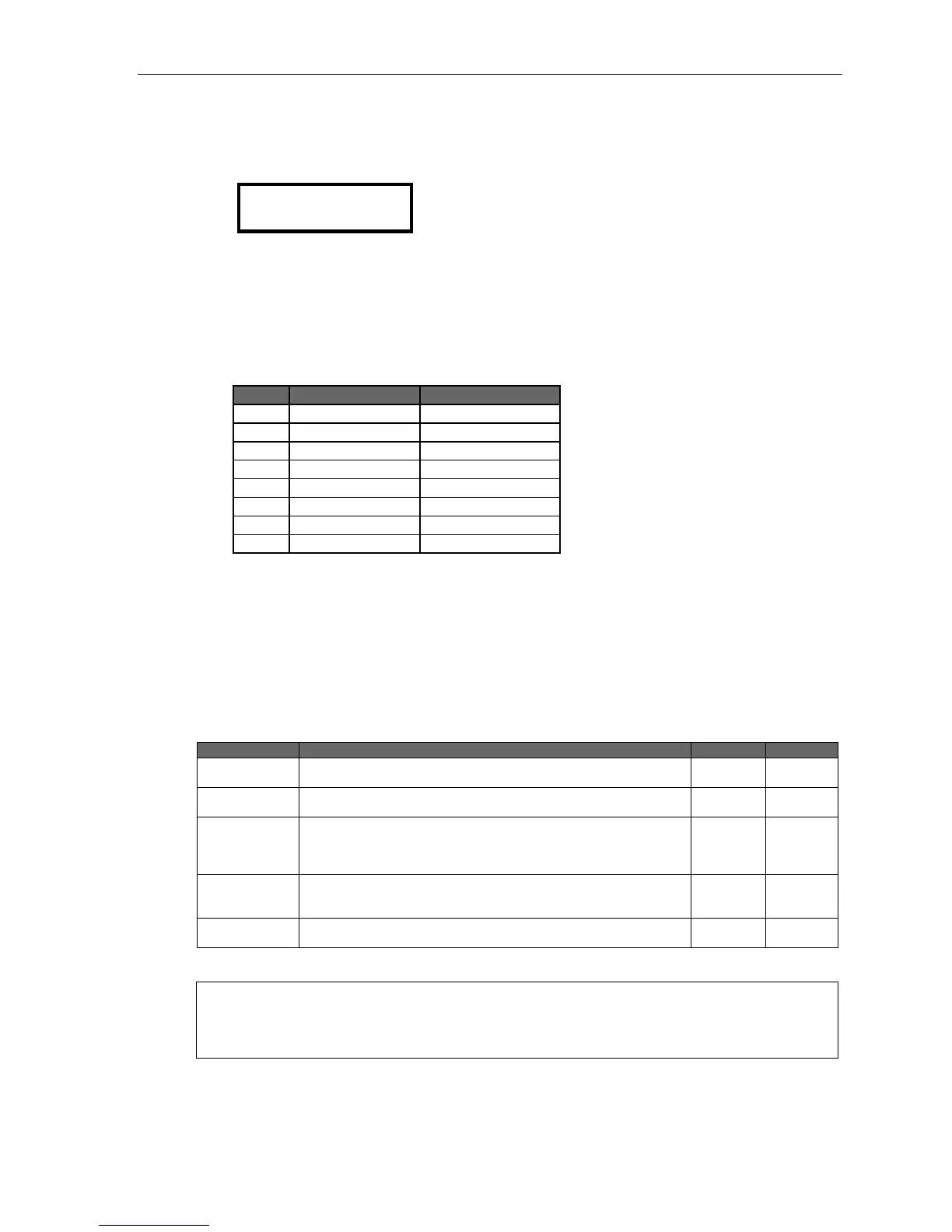
C-CARD 3 T1
FF/LC ESF/B8ZS >
If a second T1/PRI Module is installed, the system will alternate to the next T1/PRI Module. Use the scroll
keys to select the frame format and line coding. Press # to confirm.
Function 2123: Line compensation programming
Line compensation (or line build-out) is provided, as necessary, between the CSU and SmartJack and the
IP Server 900. This function allows you to adjust the line build-out of the card. The level programmed
depends on the application (CSU or DSX-1) indicated in the following table:
Level CSU line build-out DSX-1 line build-out
1 0 dB 0 to 133 feet
2 N/A 133 to 266 feet
3 N/A 266 to 399 feet
4 N/A 399 to 533 feet
5 N/A 533 to 655 feet
6 -7.5 dB N/A
7 -15 dB N/A
8 -22.5 dB N/A
Use the scroll keys to select the line build-out and press # to confirm. Default is 1.
If a second T1/PRI Module is installed, the system will alternate to the next T1/PRI Module. Select the line
build-out with the scroll key. Press # to confirm.
Function 2124: CSU emulation programming
Use the scroll keys to toggle between enabled and disabled. Default: Off. If there is no external CSU, the
CSU emulation setting should be set to On but the remaining options should be left at the default setting of
Off. When CSU emulation is enabled, the following test options will be available and should be used only
at the request of the carrier.
Test option* Description Options Default
ATT PRF
Loopback test per AT&T spec 62411 for performance assessments,
sent to the carrier on ESF trunks only.
On/Off Off
ANSI PRM
Loopback test per ANSI spec T1.403 for performance assessments,
sent to the carrier on ESF trunks only.
On/Off Off
PLB
(Payload loopback.) Accepts signal from the carrier at the chip level,
puts it through the framer (de-frames and re-frames signal with data
staying the same) and sends it back to the carrier. Used to determine
whether the chip itself is functioning correctly.
On/Off Off
LLB
(Line loopback.) Sends the signal back right at the point it enters the
chip before it enters the framer. Helps determine whether the line
itself is good.
On/Off Off
NET LLB
(Network loopback.) Lets the carrier put the DLC’s CSU into any of
the loopback modes.
On/Off Off
* Test options available only when CSU emulation is set to On.
Warning: The default setting is Off for those systems using an external CSU. If there is no external CSU, the
CSU Emulation setting should be set to On but the remaining options should be left at the default of
Off. Use these other settings ONLY at the request of your carrier or the phone system
manufacturer for testing purposes.


 To Next Page