IP Server 900 Programming Manual Function 3: Station programming
F.3
ESI digital phones
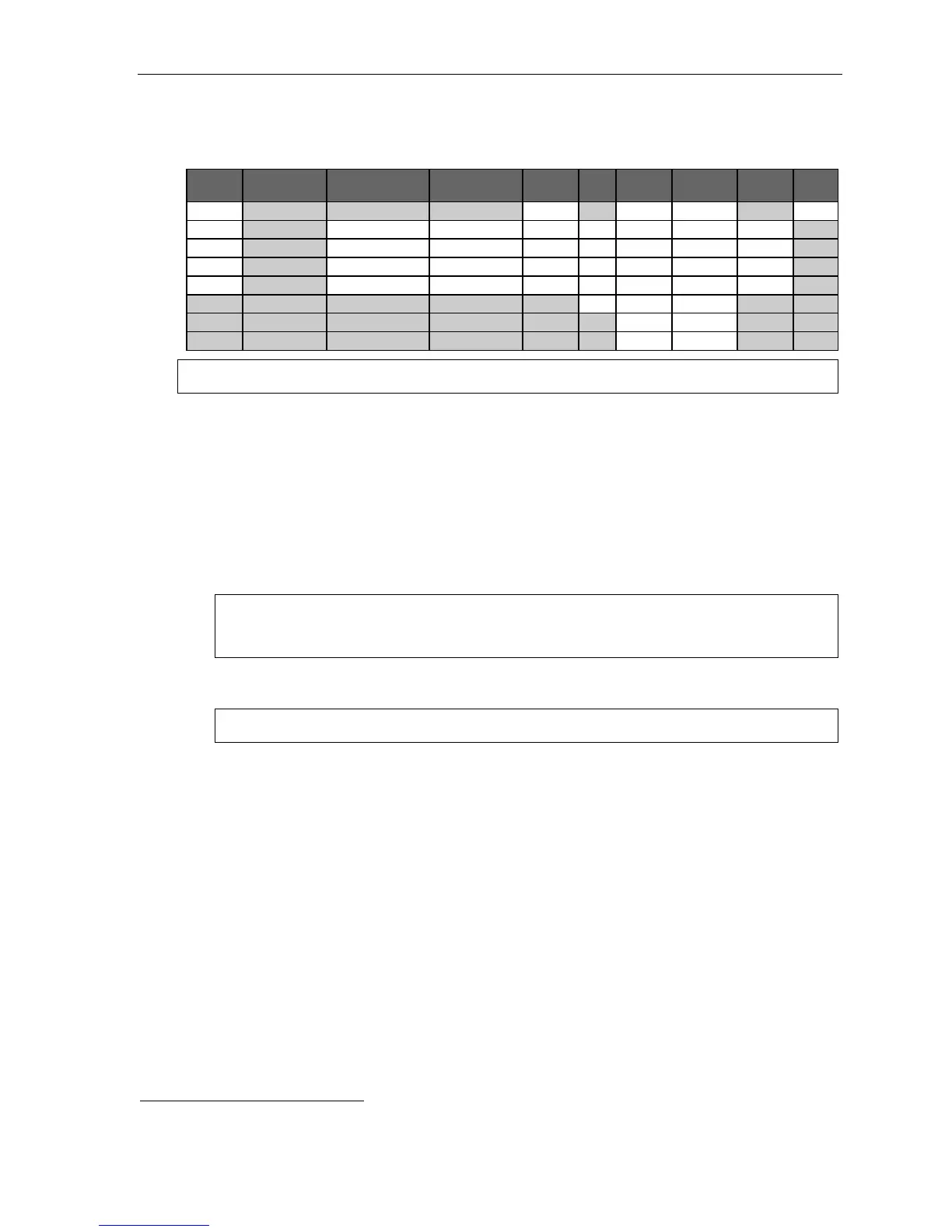
Below is an example of the portion of a completed programming worksheet for ESI digital phones.
1.
Ext.
2.
Type
3.
Name
4.
Caller ID
5.
Tenant
6.
CO
7.
CF day
8.
CF night
9.
Pg zone
10.
Ext.
0 Operator 1 X100 X100 X100
100 DIGITAL Jane 9725550010 1 9 MB100 X105 0,1,2
101 DIGITAL Roger 9725550011 1 9 MB101 MB101 0
102 DIGITAL Sally 9725550012 1 9,8 MB102 MB102 0,1
103 DIGITAL Sam 9725550013 1 9,8 MB103 MB103 0
109 EXT Roger2 9725550019 1 9 MB110 MB106
110 FAX FAX 9725550020 1 ID9999 ID9999
111 SERVER FAX SERVER 1 9 ID9999 ID9999
Note: The first station in the system defaults as OPR (when a user dials 0).
Each programming step for ESI digital phone extensions is defined as follows:
1. Extension number — Enter the extension. If you enter 0 (zero), skip to step 7.
2. Type — Based on the module installed, the IP Server 900 assigns the port as digital.
1
Special types
can be assigned (see page F.11).
3. Extension name — Used for the display, reports, and as a programming aid. The name’s length can
be no longer than 10 characters (See “Entering alphanumeric characters,” page C.2).
Default: The extension number.
4. Caller ID — Used for outgoing calls to identify the extension and for callback to the specific extension
or another extension nearby. Each entry must be valid and 10 digits in length.
Notes: For Personal Caller ID, you must have PRI service or SIP trunks.
If there is no entry here, the PRI or SIP pilot number will be sent as Caller ID.
5. Tenant — Assign the extension to a tenant. This is used to direct-dial operator (0) calls to the tenant’s
operator destination; it’s also used to play the tenant’s MOH source when calls are placed on hold.
Note: To view and assign a tenant, tenant service must be enabled in Function 169.
Default: 1.
6. CO line group — Assigns the extension’s ability to access one or more CO line groups (9, 8, and 71–76).
Default: 9.
7. Call forward busy/no answer for day mode — The extension can be set to call forward busy/no
answer to another extension (or department), a mailbox or a branch ID for day mode.
Default: The extension’s mailbox.
8. Call forward busy/no answer for night mode — Same as previous item, except night mode.
Default: The extension’s mailbox.
(Continued)
1
For programming of analog ports, see pages F.11–F.12.


 To Next Page