IP Server 900 Programming Manual Function 3: Station programming
F.18
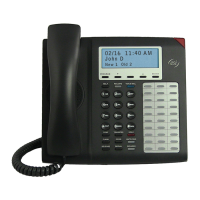
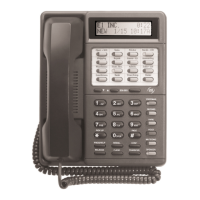
Programming an ESI IP phone for remote operation
For a list of ESI IP products that can be used remotely, see the chart on page F.13.
Note: For remote SIP phone programming, see page F.20.
When an IP phone is programmed for remote operation, this will automatically enable the phone for
DHCP
1
configuration. If the phone will be connected to a network that has a DHCP server, it will
automatically obtain the following parameters from that server:
• IP address
• IP subnet mask
• Gateway address
These parameters correspond to items 4, 5, and 6 in the following steps. If a DHCP server isn’t
available at the phone’s location, the parameters entered here will be used.
Note: If the phone displays LICENSE EXCEEDED, there are no available licenses for this extension.
Contact your ESI sales representative at 800 374-0422 to obtain more licenses or use Function 31
to “free up” licenses by deleting the MAC addresses of any unused IP extensions.
Important: If remote (off-site) operation of an IP phone is required, the phone should be connected to the
system’s network at the time of extension definition programming; if the phone wasn’t connected,
the remote IP addressing parameters won’t have been programmed into the phone. To correct
this situation, do either of the following:
— Connect the phone to the network and repeat Function 31 extension programming for this
extension, pressing # at the appropriate times to confirm previously entered values. (Performing
this step again causes the system to send the remote IP addressing information to the phone.)
— Use Esi-Address
2
to enter the critical addressing parameters (not for use with VIP 7 Softphone).
The remote (off-site) network can’t have another IP Server 900 connected to it.
Below is an example of the portion of a completed programming worksheet for remote IP phones.
1.
Ext
2.
Type
3.
MAC
4.
IP
address
5.
Subnet
mask
6.
Gateway
IP
7.
UDP
port
8.
Rem.-acc.
IP addr.
9.
Name
10.
CID
11.
Tenant
12.
CO
13.
CF
day
14.
CF
night
15.
Pg.
zone
118
Rem.
IP
00304D135661
192.168.1.3 255.255.255.252 192.168.1.1 59118 221.46.197.104 Roger 9725550504 1 9
MB
118
MB
118
119
Rem.
PC
00304D135F2F
192.168.210.5
255.255.255.252 192.168.210.1
59119 221.46.197.104 Sally 9725550985 1 9,8
MB
119
MB
119
1. Extension number — Enter an extension number.
2. Type — Use the scroll keys to select REMOTE IP or REMOTE PC; then press #.
Note: To remove a phone and its MAC address, when prompted for type press HOLD.
3. MAC address — Enter the MAC
3
address of the remote IP phone. The MAC address of the
phone appears on the second line of the display when the phone is powered up. The MAC
address is a 12-character alphanumeric address, of which the first six digits will always match
(00 30 4D). Enter the complete 12-character alphanumeric address. If programming using an
ESI desktop IP phone, use the first six programmable feature keys to enter the letters A, B, C,
D, E or F, respectively.
Notes: On an ESI IP Cordless Handset, the MAC address appears on the base station.
For VIP 7 Softphone, use the computer’s MAC address, located on the network interface
card (NIC).
1
Dynamic Host Configuration Protocol.
2
Which is available via IP Server 900 Web ESI System Programmer (WESP).
3
Media Access Control.


 To Next Page