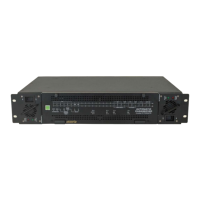
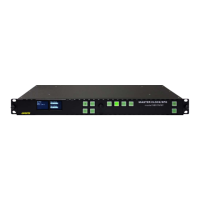
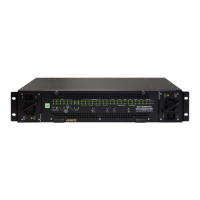
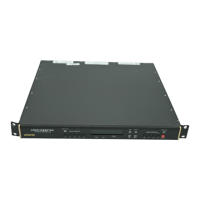
5700MSC-IP
IP Network Grand Master Clock & Video Master Clock System
Page - 38 Revision 0.2
The 5700MSC-IP can use either 10MHz or 5MHz continuous wave (CW) frequencies as a reference.
These signals are applied to the frame reference input BNCs or reference loop-through HD-BNCs and
the frequency is automatically detected by the 5700MSC-IP. With CW signals, the main oscillator
frequency is locked to the incoming reference but absolutely no phasing information is supplied. The
5700MSC-IP will arbitrarily pick an internal phase reference point once frequency lock is obtained.
Lock diagram #5 (Figure 3-11) illustrates the generation of signals when locked to a reference that
provides no phasing information.
While outputs of the same standard will be phased correctly to each other, they will not be phased
deterministically. The outputs of multiple units locked to a CW reference cannot be guaranteed to be in
phase. Furthermore, if the 5700MSC-IP unit is restarted the phase relationships can change as a new
phasing point is chosen. Likewise if the CW reference is lost, any drift accumulated during the time the
reference is absent cannot be corrected for once the reference is regained.
In order to align the output phase of two 5700MSC-IP units that are locked to a stable CW reference,
the Ten MHz Global Phase controls can be used. When the Ten MHz Global Phase is enabled, the
5700MSC-IP outputs can be phased manually to align them with another source. In this configuration,
the unit will maintain a stable phase relationship as long as the CW reference is uninterrupted and the
unit is not restarted. If a restart does occur, the 10MHz Global Phase controls are automatically
disabled and reset to zero at startup.
When a CW reference is used, the phase of the DARS and AES outputs can be anchored to either
NTSC or PAL standards. This is chosen using the AES/DARS/WC lck menu item in the AES Audio
menu. This menu item should be set to the dominant video standard that will be used in the particular
installation.
When the CW reference is lost, the 5700MSC-IP will freerun on its active oscillator, selected by the
Genlock Range menu item. The Lock type menu item controls how the 5700MSC-IP responds when
the reference is regained.
3.2.12.1. Internal Frequency Reference
When Internal Ref is selected for the frequency reference, the 5700MSC-IP will free-run on the 10MHz
output of its high-stability OCXO oscillator, regardless of the Genlock Range menu item setting. The
locking operation is similar to when locking to CW signals. The 5700MSC-IP will pick an arbitrary
phase reference to generate all outputs. This phase reference will be different between multiple
5700MSC-IP units set to free-run, and will change if the unit is restarted.
The output phase of a 5700MSC-IP that is running off its internal reference can be adjusted by using
the Internal Global Phase controls. When enabled, these controls will allow for temporarily bringing a
free-running 5700MSC-IP into phase with another piece of equipment. Although the internal oscillator
of a 5700MSC-IP is very stable, it will inevitably drift away from another reference due to the slight
variation in frequency of its internal oscillator.


 To Next Page