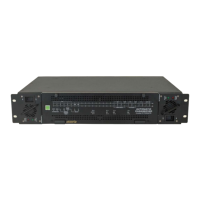
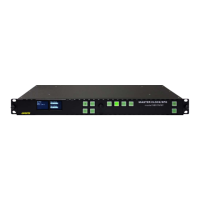
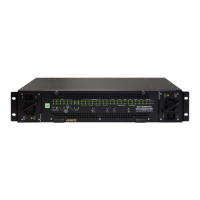
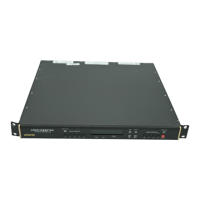
5700MSC-IP
IP Network Grand Master Clock & Video Master Clock System
Page - 54 Revision 0.2
After the 5700MSC-IP has locked to the GNSS receiver and is in a steady state condition for longer
than 20 minutes the master oscillator will be phase locked to within 15ns to 90ns of the GNSS system
time reference, depending on the number of healthy satellites that are tracked. When using multiple
5700MSC-IP units referenced to GNSS, it is important to make sure both receivers are mounted
equally so that they detect a similar number of satellites, and that the antenna cable lengths are
matched as closely as possible to limit signal path propagation delays to match their phases as closely
as possible.
If the GNSS receiver is disconnected, the ovenized oscillator within the 5700MSC-IP may drift very
slowly over time. The maximum frequency drift of the oscillator is less than 0.04Hz of subcarrier
frequency after a day of the GNSS receiver being disconnected. The drift will be less than 0.3Hz if the
GNSS receiver was disconnected or obscured from the sky for 1 year.
3.5.3. GNSS Re-Lock in Slow Mode
When the frequency lock mode is set to Slow, the 5700MSC-IP can provide a very smooth recovery of
phase upon reconnection of the GNSS antenna. There will be a very smooth transition of the
5700MSC-IP’s phase back to the GNSS system time reference. This transition is very gradual with no
non-linear jumps. Because the phase period when locked to GNSS is very long (160 seconds – see
Figure 3-12) this relock process can take a long time when the phase is considerably far off. The re-
lock will take less then 40 minutes after an unspecified period of time (i.e. 1 year or more) of the GNSS
receiver being disconnected or obscured from the sky. If the GNSS receiver is removed for 5 minutes
and then returned, the unit will take nominally less then 5 minutes to fully re-lock. If the GNSS receiver
is removed for 15 minutes and then returned, the unit will take nominally less than 20 minutes to fully
phase-lock to the GNSS system time.
3.5.4. GNSS Position Insertion into Timecode
The 5700MSC-IP can insert the current position of the GNSS antenna into the user bits of the LTC and
VITC outputs. This is controlled by the VitcLtc dte fmt menu item in the GENERAL root menu.
Timecode with even numbered frames contain longitude in the user bits, and timecode with odd
numbered frames contain latitude.
The format for latitude is wxxxyyzz where w is 1 for south (-), and 2 for north (+), xxx is degrees, yy is
minutes, and zz is seconds.
The format for longitude is wxxxyyzz where w is 3 for west (-), and 4 for east (+), xxx is degrees, yy is
minutes, and zz is seconds.
For example, at the Evertz Microsystems factory, the data is
latitude: 20432348 longitude: 30794623
This corresponds to:
North (+) 043 degrees, 23.48 minutes
West (-) 079 degrees, 46.23 minutes
It can be entered into Google maps using the format “+43 23.48 -79 46.23”.


 To Next Page