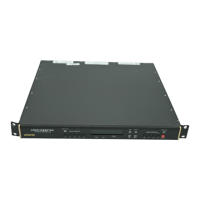
5700MSC-IP
IP Network Grand Master Clock & Video Master Clock System
Revision 0.2 Page - 51
Depending on the IRIG format selected, different types of information may be placed in the IRIG
frame. The Time-of-Year portion is always present and indicates the current system clock time in
seconds, minutes, hours, and day of the year. The IRIG-B120, IRIG-B123, and IRIG-B127 formats
include a straight binary seconds counter which gives the current time of day in seconds. The IRIG-
B127 format also includes the current year as a two-digit number (e.g. 2011 = 11). The IRIG timecode
is generated directly from the system clock, which should be set to UTC.
The LTC outputs (with the 5700MSC-IP+AUX option) can be configured to one of the four IRIG
formats in their respective menus. The IRIG signal amplitude can be controlled by the Output Level
menu item. When an LTC output has been configured to an IRIG output mode, both primary and
secondary outputs will provide the same IRIG signal.
The 5700MSC-IP can also be configured to the IRIG-B as a time reference. The time reference source
must first be set to IRIG. The Irig Mode menu item selects which IRIG format to use as a reference
and can also enable auto detection. Only IRIG-B127 can provide full date information.
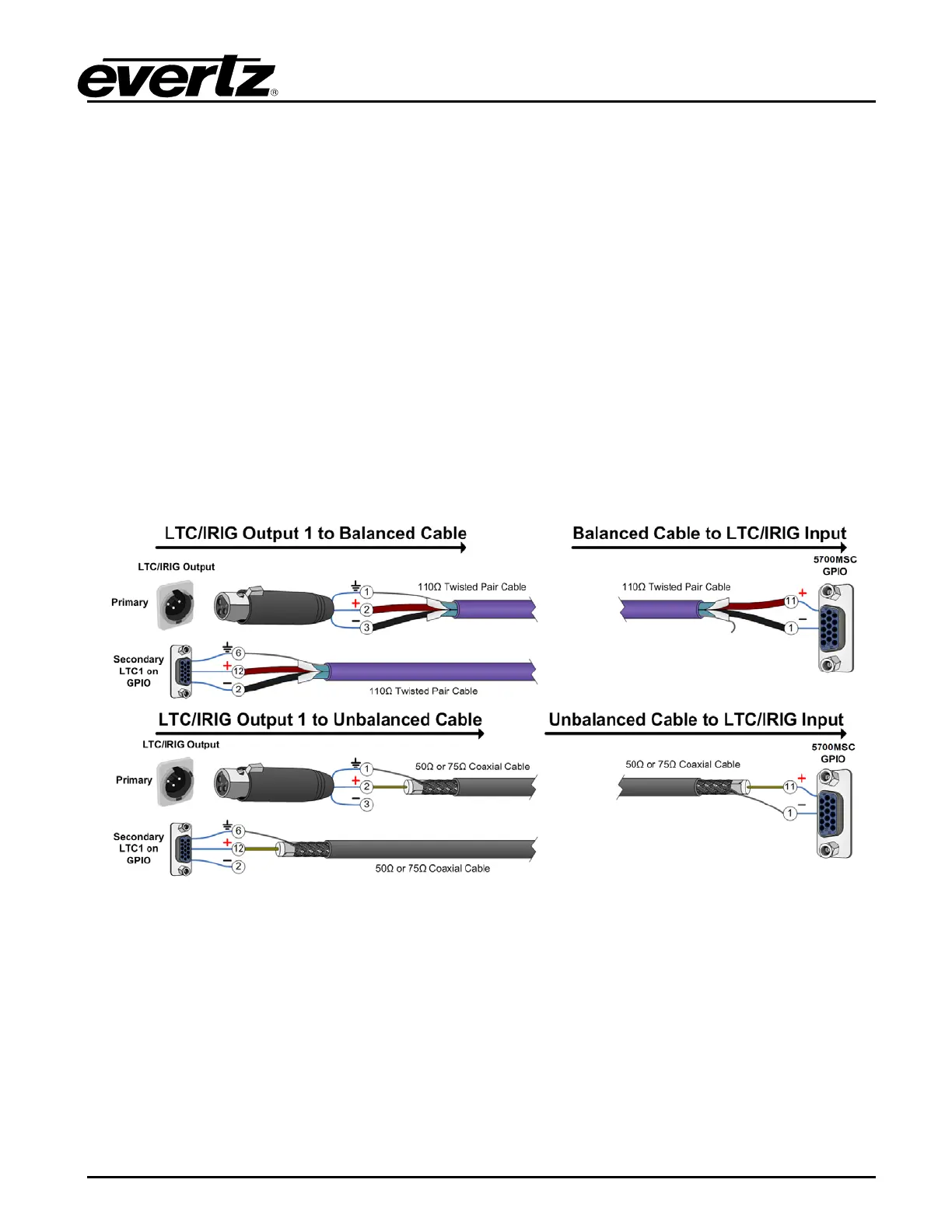
Both IRIG input and output circuitry is balanced. To connect an unbalanced IRIG source to the LTC
input, or to use the LTC outputs to drive an unbalanced IRIG cable, refer to Figure 3-21 for examples
on how to make these connections.
Figure 3-21: IRIG Input and Output Connections
3.4. NETWORK TIME PROTOCOL (NTP)
If the 5700MSC-IP has an available Network Time Protocol (NTP) server, it runs on the CONTROL
Ethernet port using the IP address assigned to the port. The NTP features are configured in the NTP
Rules menu located in the GENERAL root menu.
The 5700MSC-IP implements version 3 of the NTP protocol as defined in RFC 1305. The NTP server
uses the system clock as its source of time. This requires the system clock to be set to UTC in order
to generate a valid NTP timestamp. The contents of the packets are largely determined by the chosen
time reference and the lock status.


 To Next Page