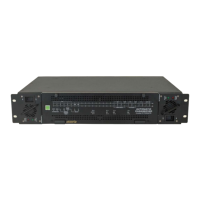
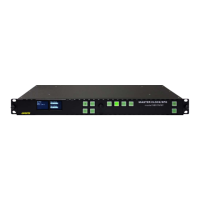
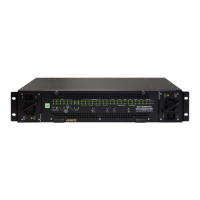
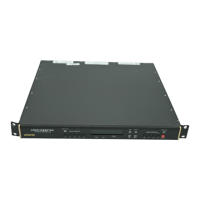
5700MSC-IP
IP Network Grand Master Clock & Video Master Clock System
Revision 0.2 Page - 63
4.4. CONNECTING TWO 5700MSC-IP UNITS IN SYNCRO MODE
When two 5700MSC-IPs are connected in a redundant configuration with an automatic changeover
unit, it is necessary that both 5700MSC-IP units have the same timing and output settings. Identical
timing for the 5700MSC-IPs is assured by locking both to the same frequency and phase source (e.g.
GNSS or by genlocking one unit to the other). Ensuring that both 5700MSC-IPs have the same output
configuration and time can be accomplished by implementing syncro between the two units.
The syncro link is automatically made when the GPIO connector of both 5700MSC-IP units is
connected to the automatic changeover unit using male-to-male DB15 cables. Once the two units are
connected, one must be designated the master unit and the other the slave. The slave unit will copy all
the output menu settings from the master unit so that any change done on the master (such as
changing a test pattern or phase offset) will also be applied to the slave. Additionally, the master
5700MSC-IP can be used as a time reference by the slave unit, with the time and date being
transmitted through the syncro link.
To use syncro, the master 5700MSC-IP must be set to one of the master syncro modes. Likewise, the
slave 5700MSC-IP must be set to a slave mode. When the master 5700MSC-IP has been configured
to send syncro information and the slave 5700MSC-IP has been configured to receive it, the state of
the link can be viewed on the slave unit by pressing the STATUS button and selecting the Inputs
status screen. The slave unit will indicate Syncro link ok. When the link has been established, the
slave unit can also set its time reference source to Syncro and will obtain time through the link as well
as menu settings.
When syncro menu mode is active, all of the menu settings in the OUTPUT root menu are copied from
the master 5700MSC-IP to the slave unit. The menu settings in the INPUT and GENERAL menus are
not affected by syncro. In the OUTPUT menu the SDI TGs can be excluded from syncro. This can be
done individually for each test generator.
4.5. GNSS RECEIVER INSTALLATION
The 5700MSC-IP unit is designed to work with the Trimble Acutime 360 antenna. The Smart Antenna
houses the GNSS receiver, antenna, power supply and other support circuitry in a sealed, shielded,
self-contained unit with a digital interface to the main unit. The GNSS Smart Antenna also receives
power from the main unit through the connection cable.
4.5.1. Mounting the GNSS Smart Antenna
The smart antenna's enclosure is completely waterproof and is designed for outdoor installation. It is
protected against interfering signals and thus is suitable for reliable operation in most environments.
Select an outdoor location for the antenna, like the roof of your building that has a relatively
unobstructed view of the sky. Dense wood and concrete or metal structures will shield the antenna
from satellite signals. The antenna can receive satellite signals through glass, canvas and thin
fibreglass; thus it may be mounted inside a skylight, if an outdoor location is not possible.
The smart antenna is an active-head antenna. For optimal performance, locate the smart antenna as
far as possible from transmitting antennas, including radar, satellite communication equipment and
cellular transmitters. When locating the antenna near a radar installation, ensure that the antenna is
positioned outside of the radar's cone of transmission. Follow the same guidelines when installing the
antenna near satellite communication equipment. For best results, mount the antenna at least ten feet
away from satellite communication equipment. Do not mount the antenna near high vibration areas
such as fan or motor housings, or near sources of heat such as exhaust stacks.


 To Next Page