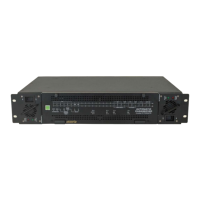
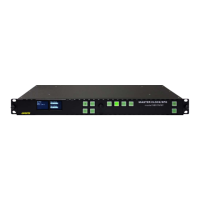
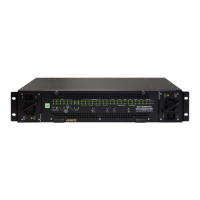
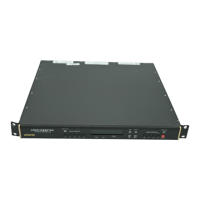
5700MSC-IP
IP Network Grand Master Clock & Video Master Clock System
Page - 44 Revision 0.2
timecode output is running at a different frame rate than the LTC input, then the time is rounded to the
nearest frame before being jammed into the output’s timecode clock.
3.3.3.3. VITC Time Reference
The 5700MSC-IP can read Vertical Interval Time Code (VITC) from a SMPTE ST 318 compliant color
black signal that is applied to the reference loop input. The VITC can be on any line of the incoming
color black video from line 6 to line 31. The VITC reader line is set by the Vitc Line menu item. The
5700MSC-IP can read 25Hz VITC extracted from a PAL-B reference signal, and 29.97Hz dropframe
VITC extracted from an NTSC-M reference signal.
Date information can be decoded from the user bits of the VITC. The date format is selected using the
VitcLtc Date menu item. The automatic detection mode works well for Legacy and SMPTE formats, but
may not work reliably for Production date formats. If there is no date information on the incoming VITC
or if the user bits are being used for another purpose, the date decoder must be disabled by setting it
to No Date. This prevents false date decoding that may trigger spurious time jam events or warnings.
When the date decoder is disabled, the date can be manually set using the Set System Date menu
item in the GENERAL root menu.
The 5700MSC-IP will continuously compare the system clock to the incoming VITC timecode. When
a difference of more than 2 milliseconds is detected the 5700MSC-IP will generate a jam event, or a
jam warning depending on the Lock Type setting. When a jam event occurs, the time read from the
VITC input is jammed into the system clock. At the same time, the VITC input time is jammed into the
timecode output clocks.
When the incoming VITC is jammed into a particular output timecode clock, it may be adjusted to
maintain color frame alignment and to match the output frame rate. If a particular timecode output is
the same frame rate as the incoming VITC, the time is copied directly into the output’s clock. If the
timecode output is running at a different frame rate than the VITC input, then the time is rounded to the
nearest frame before being jammed into the output’s timecode clock.
In order to use VITC as a time reference, the frequency reference must be set to
Video.
3.3.3.4. IRIG Time Reference
When the IRIG option is installed, the 5700MSC-IP+AUX will be able to read IRIG-B timecode that is
applied to the LTC input on the GPIO connector. The IRIG type is auto-detected. Only the IRIG-B124
and IRIG-B127 formats supply complete date information. If other formats are used, the system date
will have to be set manually using the Set System Date menu item in the GENERAL root menu.
The system clock is continuously compared with the incoming IRIG timecode. When a difference of
more than 5.5 milliseconds is detected the 5700MSC-IP+AUX will flag that a time jam is required. The
time Lock Type menu item controls how the 5700MSC-IP+AUX responds when a time jam is needed.
3.3.3.5. SNTP Time Reference
The 5700MSC-IP can jam its system clock to an external NTP server. Unlike with other time
references, this synchronization is not continuous and happens once a day. The time Lock Type is
forced to Daily, and the Input Jam Time control sets the time of day the synchronization happens. Up


 To Next Page