A-9VTG 400/400D • Appendix
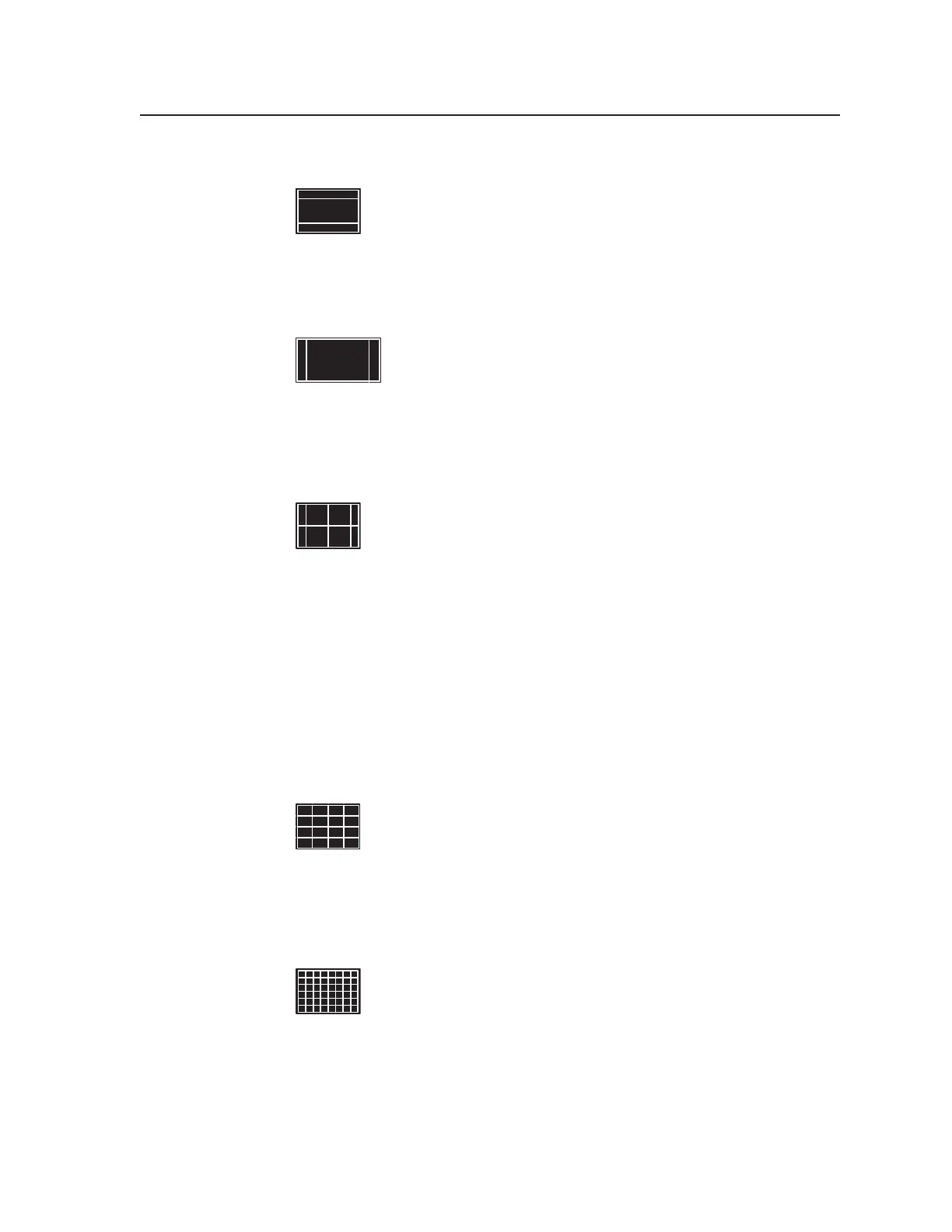
4. 16:9 Crop (4:3 rates)
This test pattern is used to display the resulting letterbox effect of a
widescreen (16:9) image within a standard 4:3 display system. The
outer border corresponds to the maximum dimensions of a 4:3
image for the given line rate. The two horizontal lines within the
pattern show the area and boundaries of a 16:9 image within a 4:3 space. Use
this pattern for setting or creating screen masking systems.
4:3 Crop (16:9 rates)
This test pattern is used to display the resulting side-boxing
effect of a standard 4:3 image within a 16:9 widescreen display
system. The outer border corresponds to the maximum
dimensions of a 16:9 image for the given line rate. The two
vertical lines within the pattern show the area and boundaries of a 4:3 image
within a 16:9 image space. Use this pattern for setting or creating screen
masking systems.
5. Rectangle/Square Crosshairs
This pattern can be used to properly center the image and set
geometry. For CRT-based projectors, this pattern is used to check
and adjust gross linearity and static convergence. Regardless of
whether the VTG is set for a 4:3 or 16:9 aspect ratio, this pattern
provides a perfectly centered square, which is useful for basic geometric
alignment of the projector and the projector-to-screen relationship.
Orthogonal alignment of the projector to the screen is critical for best overall
focus and image geometry. Utilizing a simple square allows the installation
technician to easily measure from the projector’s lens axis location to each corner
of the test square for determination of orthogonal alignment. In addition, the
outer line provides a border indicating the extreme boundary of the image. It is
important that the border line be just visible inside the screen boundaries. The
crosshair lines through the center of the pattern provide an easy target for static
convergence adjustment of a CRT projector or evaluation of video delay skew.
6. 4x4 Crosshatch
Crosshatch patterns are traditionally used for linearity and
convergence adjustment (both static and dynamic) of CRT-based
displays. Additionally, this particular 4 x 4 pattern is useful for
calibrating the position of picture-in-picture display boxes. It may
also be used to calibrate the division of the screen for multiplexed images such as
in video wall applications or video multiplexing processors handling several
images simultaneously.
7. Coarse Crosshatch
Crosshatch patterns are traditionally used for linearity and
convergence adjustment (both static and dynamic) of CRT-based
displays. The coarse crosshatch pattern may be appropriate for
adjustment where more points of interest are required for optimum
adjustment of large projected images. It may also be used for critical skew
alignment of the red, blue, and green signals within a twisted-pair video
transmission system.
Crosshatch patterns are typically generated using one-pixel wide vertical lines
(highest frequency in a given scan rate) and one-line wide horizontal lines in the
vertical scanning domain. This feature makes the pattern useful for measuring
Tel. 07131 911201
Fax 07131 911203



 To Next Page