A-17VTG 400/400D • Appendix
NTSC – White reference bar followed by 0.5, 1, 2, 3, 3.58, and 4.2 MHz bursts
PAL – White reference bar followed by 0.5, 1, 2, 4, 4.43, and 5 MHz bursts.
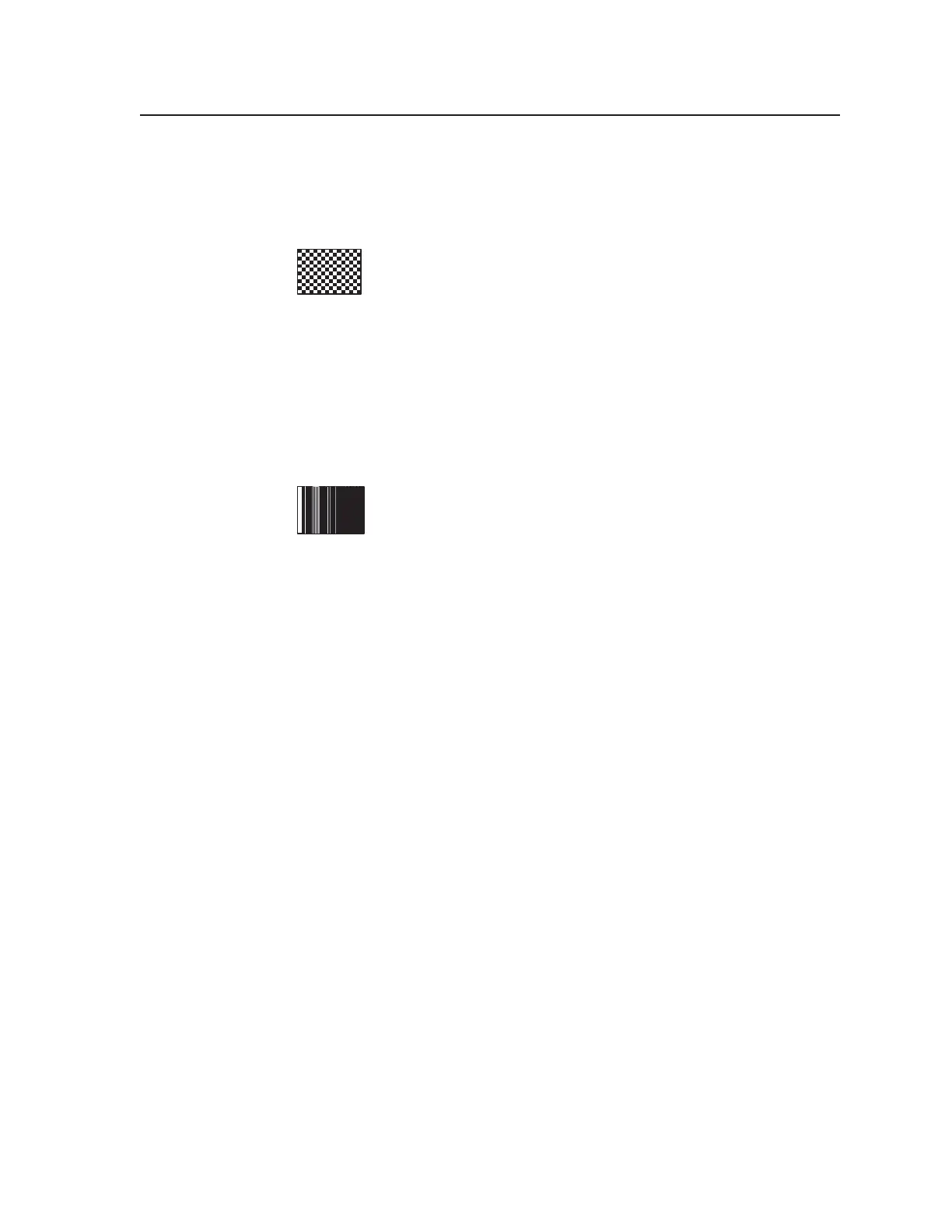
24. Alternating Pixels (2-dimensional)
This pattern is similar to the alternating pixel pattern discussed
earlier; however, while it consists of one-On, one-Off alternating
pixels on each horizontal line, the phase is shifted 180 degrees for
every other line thereby creating a minute checkerboard effect.
Because of the line-to-line phase shift, this pattern is useful for critically
evaluating pixel timing and phase in a graphics display system. The pattern is
produced at the highest clock rate required for the selected image resolution.
Incorrect pixel digitization within a display manifests on the screen as regions of
“dancing pixels”, instability, or noise in the test pattern. Pixel timing and phase
may be adjusted in most fixed pixel displays until any abnormal noise effects are
nullified.
Multipulse
The multipulse pattern is uniquely applied to evaluation of group
delay in television signal distribution systems. Individual
frequencies propagate along cables, such as coaxial cables, at
different speeds. High frequencies are affected more than lower
frequencies relative to one another. The rate at which signals of differing
frequencies propagate manifests as time of one signal component to the other.
This phenomenon is referred to as group delay.
In the case of NTSC or PAL television signals which contain many frequency
components that must maintain strict timing relationships, the chroma signal
typically becomes misaligned in time (delayed) compared to the luminance
transitions. This results in poor edge quality and fidelity for areas containing
color information since the color information is not only delayed, but suffers
amplitude loss as well.
The multipulse consists of a low frequency level or “white bar” which indicates
maximum video signal level. This bar is followed by a series of pulses. The first
pulse is a 2T pulse without any modulation. The 2T pulse represents the highest
frequency component in the television luminance channel. When its amplitude
is maintained at the same level with the bar throughout the system distribution,
the low to high frequency response is considered satisfactory.
NTSC Multipulse
The 2T pulse is followed by a series of modulated pulses: First, a 20T pulse
encompassing a 1 MHz sine wave burst, followed by a 12.5T pulse containing a
2 MHz sine wave burst, followed by a 12.5T pulse containing a 3 MHz sine wave
burst, followed by a 12.5T pulse containing a 3.58 MHz sine wave burst,
followed by a 12.5T pulse containing a 4.2 MHz sine wave burst. Much like the
multiburst signal discussed earlier, each of these frequencies provides an
intermediate bandwidth point for consideration, including the color subcarrier
and a frequency burst at the bandwidth limit of the system.
The frequency burst inside each pulse is generated to fit within the pulse
symmetrically and have an amplitude that matches the pulse height and
duration without extending past its areal limits. Group delay in a television
distribution system causes relative time shift between the imposed burst and the
encompassing pulse. Amplitude disturbance of the burst within each pulse
manifests as an upward or downward level shift, which appears as concaved
upward above black level for low level to convexed downward beyond black for
excessive level.
Tel. 07131 911201
Fax 07131 911203



 To Next Page