General
1-30
Removing Broken Fasteners
If the head breaks off a screw or bolt,
several methods are available for
removing the remaining portion. If a large
portion of the remainder projects out, try
gripping it with locking pliers.
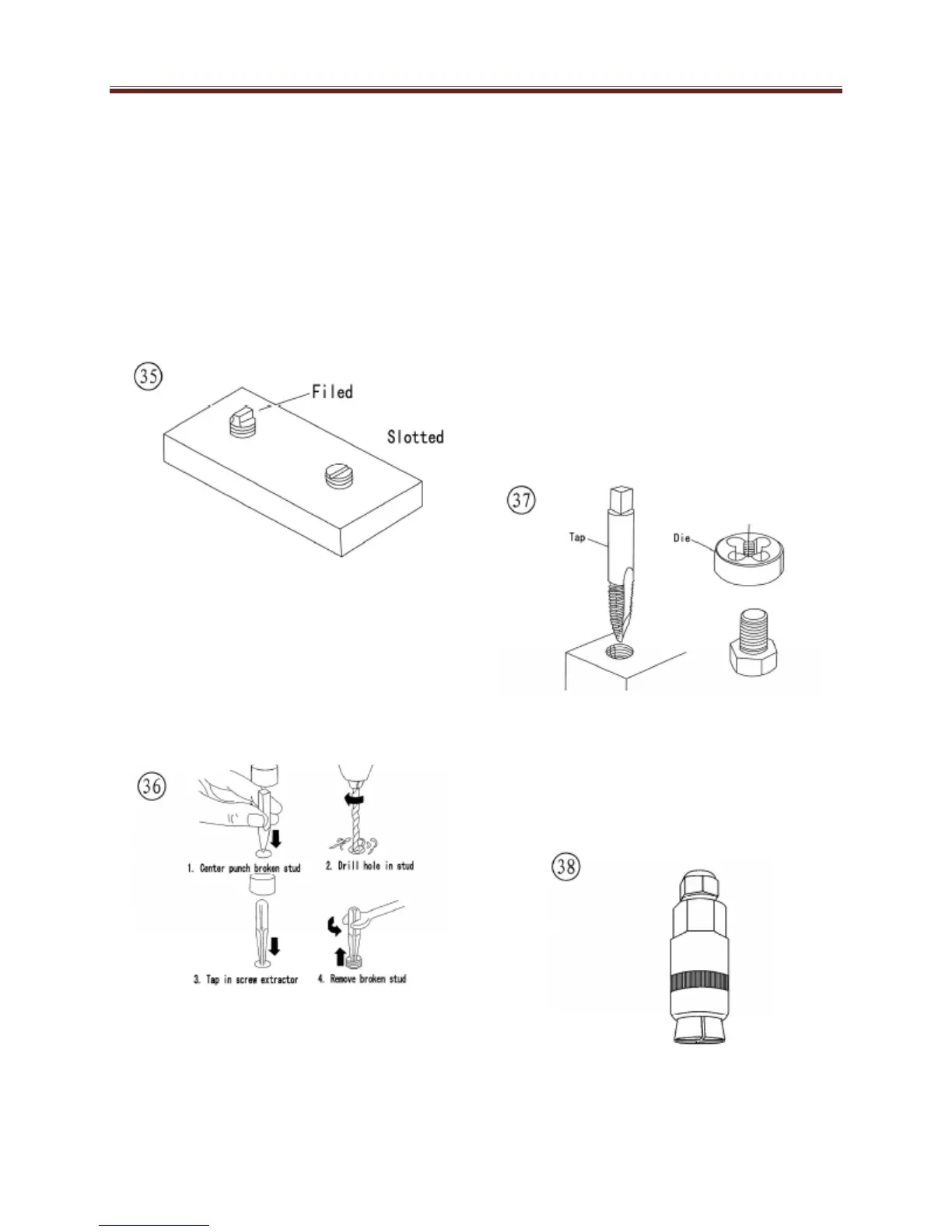
If the projecting portion is too small, file it
to fit a wrench or cut a slot in it to fit a
screwdriver (Figure 35).
If the head breaks off flush, use a screw
extractor. To do this, center punch the
exact center of the remaining portion of the
screw or bolt. Drill a small hole in the
screw and tap the extractor into the hole.
Back the screw out with a wrench on the
extractor (Figure 36).
Repairing Damaged Threads
Occasionally, threads are stripped through
carelessness or impact damage. Often the
threads can be repaired by using a tap (for
internal threads on nuts) or a die (for
external threads on bolts) (Figure 37). To
clean or repair spark plug threads, use a
spark plug tap.
If an internal thread is damaged, it may be
necessary to install a Helicoil or Timesert
(types of thread insert). Follow the
manufacturer’s instructions when installing
their insert. If it is necessary to drill and tap
a hole, refer to Table 8 for metric tap and
drill sizes.
Stud Removal/Installation
A stud removal tool (Figure 38) is
available from most tool suppliers. This
tool makes the removal and installation of
studs easier.



 To Next Page