Function description
OPERATION MANUAL Chapter 3
CC® Liability for errors and misprints excluded. V1.3.0en/06.07.15//14.06
3.2.2 Information about Huber thermal fluids
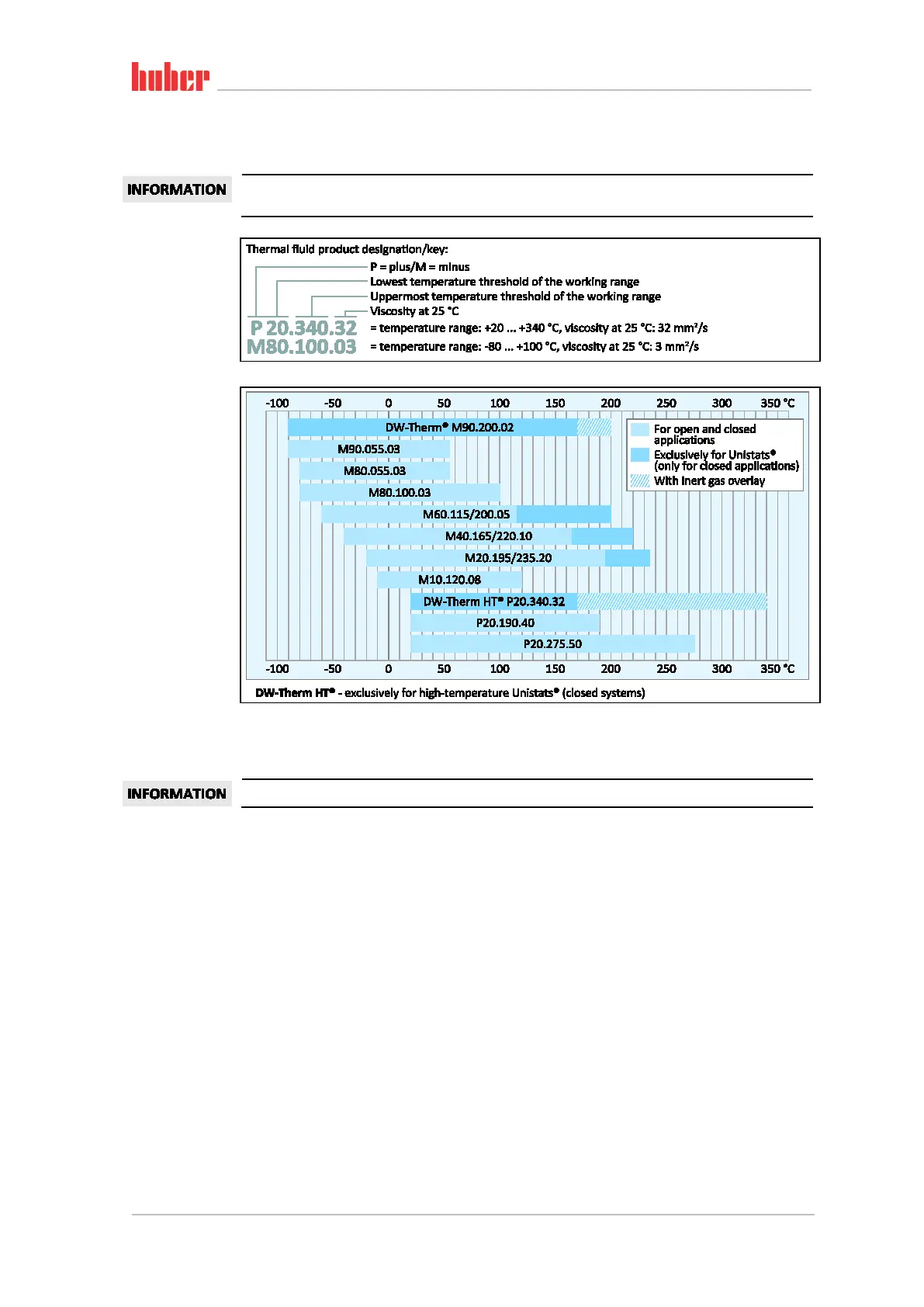
For thermal fluids we recommend the media listed in the Huber catalog. The name of a thermal
fluid is derived from its working temperature range and its viscosity at 25 °C.
3.3 To be noted when planning the test
Also observe page 15 in section »Proper operation«.
The focus is on your application. Bear in mind that system performance is influenced by heat trans-
fer, temperature, thermal fluid viscosity, volume flow and the flow speed.
▪ Make sure that the electrical connection is adequately dimensioned.
▪ The installation location of the temperature control unit should be selected so as to ensure ade-
quate fresh air, even with water-cooled chillers.
▪ With pressure-sensitive applications, such as glass reactors, the maximum forward flow pressure
of the temperature control unit must be taken into account.
▪ A cross-section reduction or shut-off in the thermal fluid circulation must be avoided. Take corre-
sponding measures to limit the pressure in the system; see data sheet from page 83 in Section
»Annex« and the data sheet for your glass apparatus.
▪ With temperature control units without pressure limitation, check whether it is necessary to use
an external bypass.
▪ To prevent the danger of over-pressure in the system, the thermal fluid must always be brought
to room temperature before switching off. This will prevent damage to the temperature-control
device or the application. Any isolating valves must remain open (pressure equalization).
▪ The temperature and the dynamics of the process are determined by the flow temperature. A
differential temperature (Delta T) forms between flow temperature and process temperature.
This temperature difference may have to be limited, because Delta T might exceed limits of the
application (glass apparatus) and cause bursting. Adjust the Delta T value to your application.
Thermal fluid product
name/product key
Overview:
Working temperature
ranges of Huber
thermal fluids


 To Next Page