Service/maintenance
Chapter 7 OPERATION MANUAL
V1.3.0en/06.07.15//14.06 Liability for errors and misprints excluded. CC®
7.5 Thermal fluid inspection, replacement and circuit cleaning
The illustration “Wiring diagram” can be found on page 83 in section »Annex«.
7.5.1 Thermal fluid inspection
Thermal fluid is not inspected on a regular basis
BURNS DUE TO REDUCED BOILING POINT
Regularly check your thermal fluid whether it meets the specifications in the safety data sheet.
Thermal fluid is not inspected on a regular basis
DAMAGE TO THE HEAT EXCHANGER AND/OR ELECTROMECHANICAL PARTS.
Regularly check your thermal fluid whether it meets the specifications in the safety data sheet.
Oxidation
Oxidation ages the thermal fluid and changes its characteristics (e.g. reduced boiling point). The
reduced boiling point may cause overflow of very hot thermal fluids at the >Expansion vessel< [18]
during temperature control of high temperatures. It may cause serious burns of the limbs.
Hygroscopy
During continuous temperature control below room temperature the thermal fluid accumulates
water by hygroscopicity over time. Such a liquid mixture causes the evaporator to burst during
temperature control in the minus range. This is caused by the water in the liquid mixture, which
forms ice crystals on the evaporator. A temperature control of such a liquid mixture at high tem-
peratures reduces the boiling point. A temperature control at high temperatures may cause an
overflow of very hot thermal fluid at the >Expansion vessel< [18] as a result of the reduced boiling
point. It may cause serious burns of the limbs.
7.5.2 Cleaning the thermal fluid circuit
Non-compliance with the safety data sheet for the thermal fluid to be used
INJURIES
Risk of injury to the eyes, skin, respiratory tract.
The safety data sheet for the thermal fluid to be used must be read prior to use and its con-
tents respected.
Observe the local regulations/work instructions.
Wear your personnel protective equipment (e.g. temperature-resistant safety gloves, safety
goggles, safety footwear).
Danger of slipping through contamination of floor and work area.
Using the wrong cleaning agents for cleaning the thermal fluid circuit
DAMAGE CAUSED BY LEAKS IN THE INTERNAL THERMAL FLUID CIRCUIT
Do not use acetone as a cleaning agent.
Use only suitable cleaning agents.
The inner components of the temperature control unit must be dried out Need to avoid boiling
retardation during future uses (e.g. use of a silicone oil at temperatures above about 100 °C).
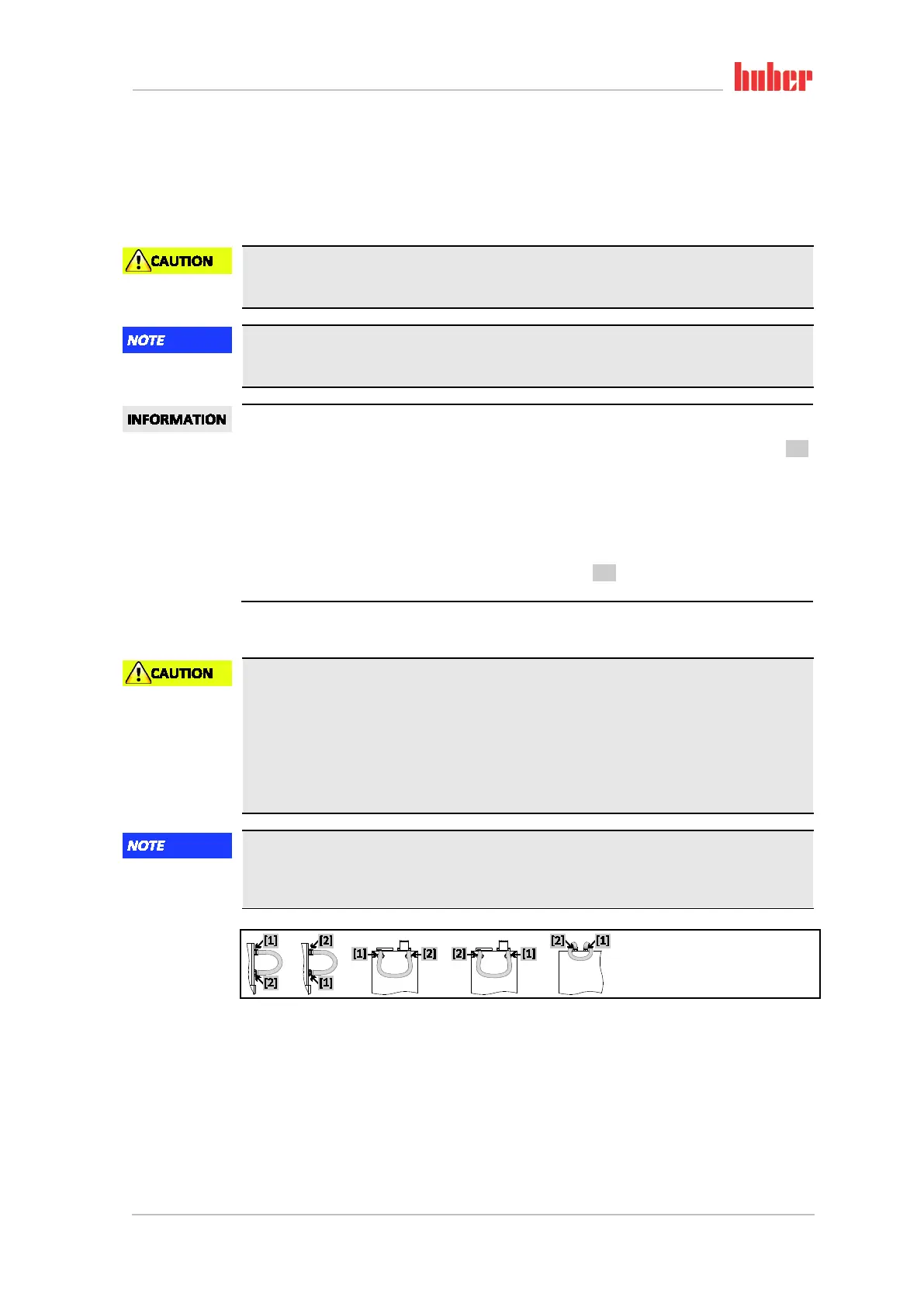
Example: Connecting a
short circuit hose


 To Next Page