Version V1.0
24
◼
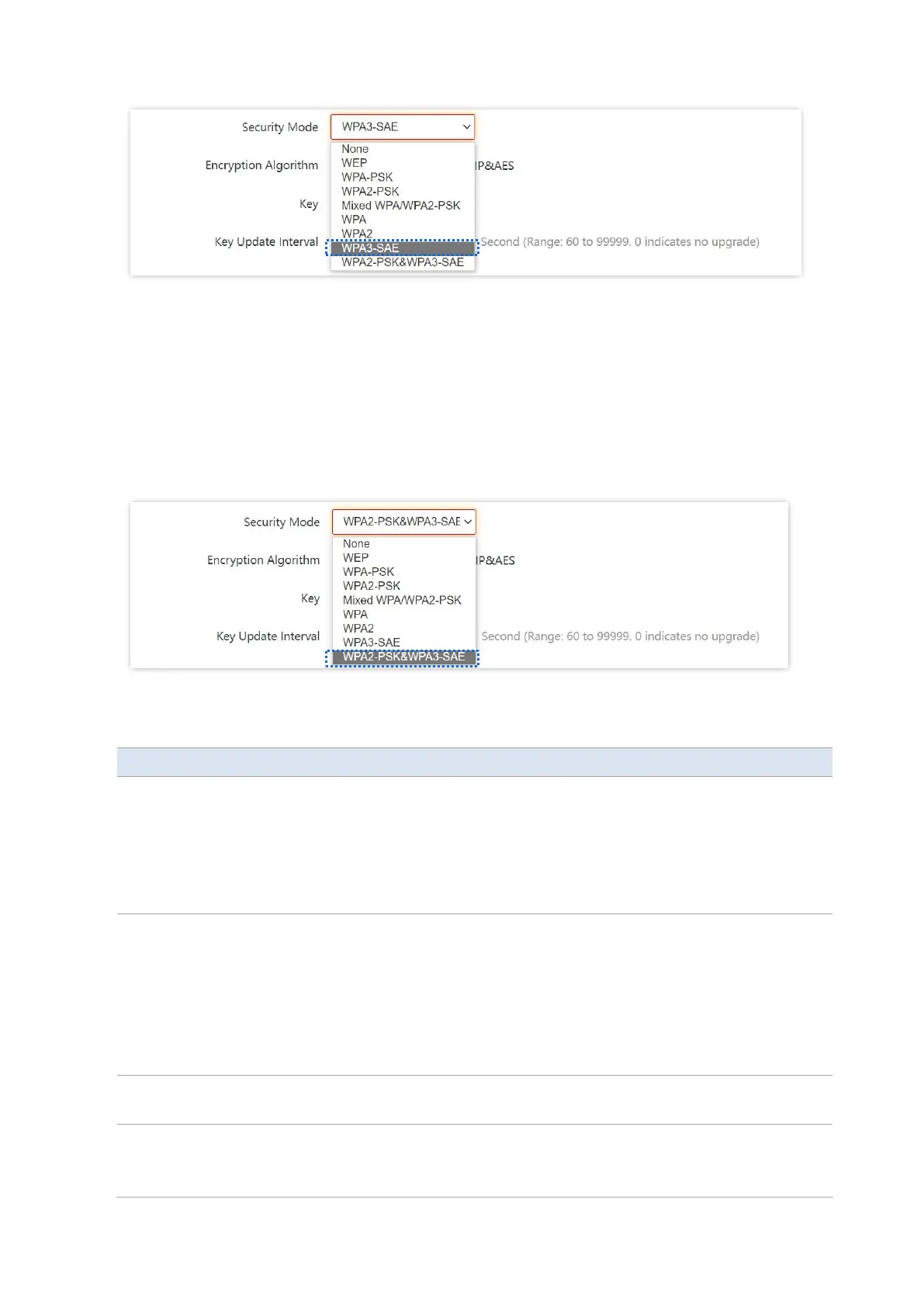
WPA2-PSK&WPA3-SAE
It indicates that the AP is compatible with both WPA3-SAE and WPA2-PSK security modes.
WPA2 is still widely used currently. To allow wireless devices that do not support WPA3 to
access the WPA3 network, the AP supports the WPA3-SAE transition mode, which means that
the mixed encryption mode of WPA2-PSK and WPA3-SAE is adopted to ensure both
compatibility and security.
Parameter description
Select security mode.
−
WPA3-SAE: The wireless network adopts the WPA3-SAE security mode, which
is an upgraded version of WPA2-PSK.
−
WPA3-SAE/WPA2-PSK: Compatible with WPA3-SAE and WPA2-PSK. At this
time, wireless devices can connect to the corresponding wireless network
using both WPA3-SAE and WPA2-PSK.
It specifies the encryption algorithm corresponding to the selected security mode.
−
AES: It indicates the Advanced Encryption Standard.
−
TKIP: It indicates the Temporal Key Integrity Protocol. If TKIP is used, the
maximum wireless throughput of the AP is limited to 54 Mbps.
−
TKIP&AES: It indicates that both TKIP and AES encryption algorithms are
supported. Wireless clients can connect to the wireless network
corresponding to the selected SSID using TKIP or AES.
It specifies a pre-shared WPA key, that is, the password clients use to connect to
the wireless network.
It specifies the automatic update interval of a WPA key for data encryption. A
shorter interval results in higher data security.
The value 0 indicates that a WPA key is not updated.



 To Next Page