169441 48 Revision D
6. Hold shoe (B) and remove adjustment pin (C) by
disengaging it from the frame and pulling it away from
the shoe.
7. Raise or lower skid shoe (B) to achieve the desired position;
use the holes in the support as a guide.
8. Reinstall pin (C), engage it in the frame, and secure it with
lynch pin (A).
9. Ensure that all skid shoes are equally adjusted.
10. Check the header float as described in your windrower
operator’s manual.
3.12.2 Header Float
D Series Draper Headers are designed to ride on the skid shoes when cutting on the ground. The windrower float system
reduces the ground pressure so that the header floats over obstacles and follows ground contours instead of being
supported by the windrower lift cylinders.
Refer to your windrower operator’s manual for details about header float adjustments.
3.12.3 Header Angle
Header angle can be adjusted to accommodate different crop conditions and/or soil types.
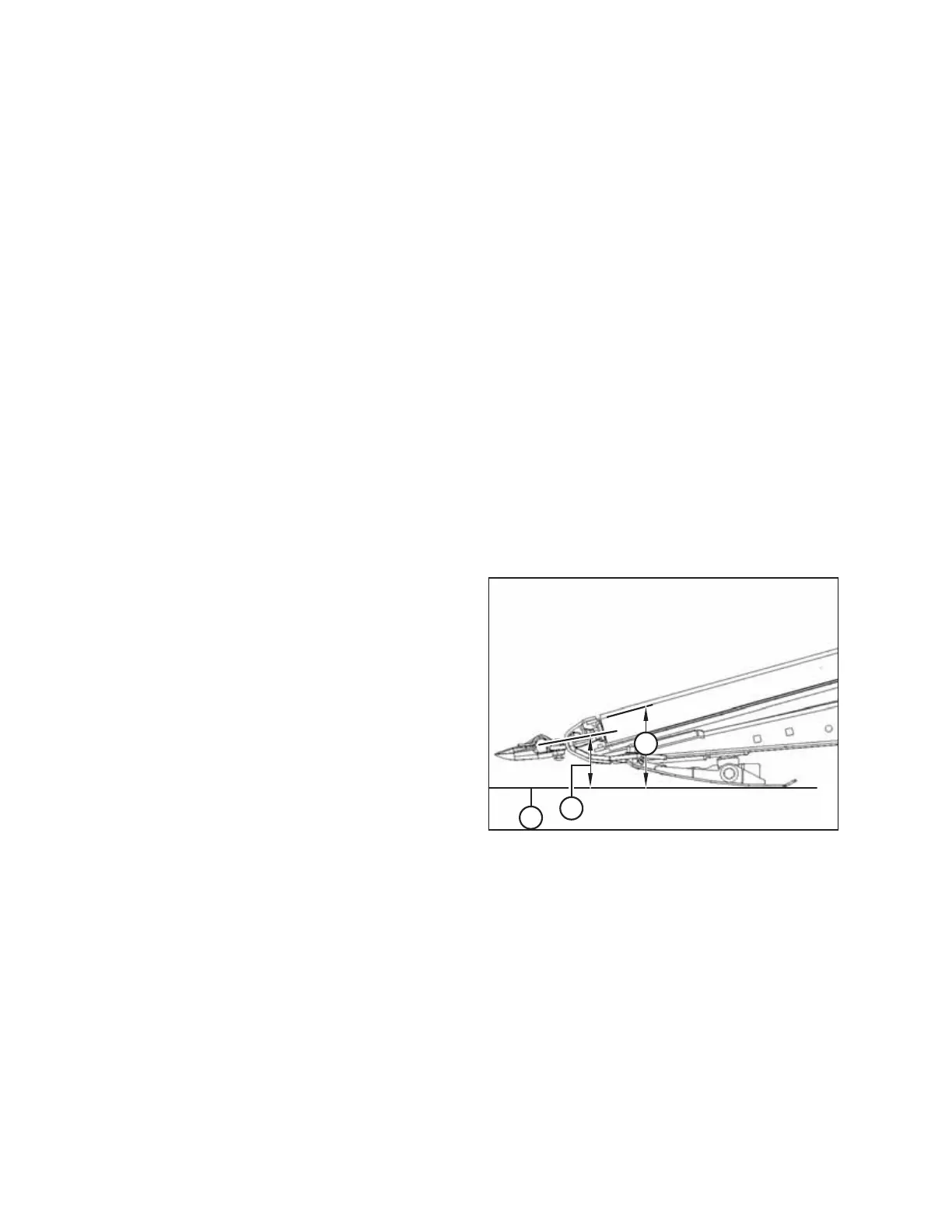
Figure 3.29: Shortest Center-Link
The header angle (A) controls the distance between the draper
and ground (B) and is a critical component for effective cutting
on the ground. The header angle is similar to guard angle (C),
which is the angle between the upper surface of the guards and
ground (B).
Flatter header angles are recommended for normal crop
conditions and for stony ground because it minimizes knife
section breakage, and reduces soil scooping or build-up at the
cutterbar in wet conditions.
Steeper angles are recommended in downed crops for better
lifting action, or for cutting close to the ground in hay for
example. Refer to 3.12.10 Reel Tine Pitch, page 63 and 3.12.9
Reel Fore-Aft Position, page 55 for adjustment details.
OPERATION



 To Next Page