When the cycling sequence and the crosshead has stopped at a soft limit, the limit condition may be
overridden by pressing and holding either directional button.
5.6.1 Dwell time
Dwell time is the amount of time, in seconds, for which the crosshead stops at a limit during a cycle
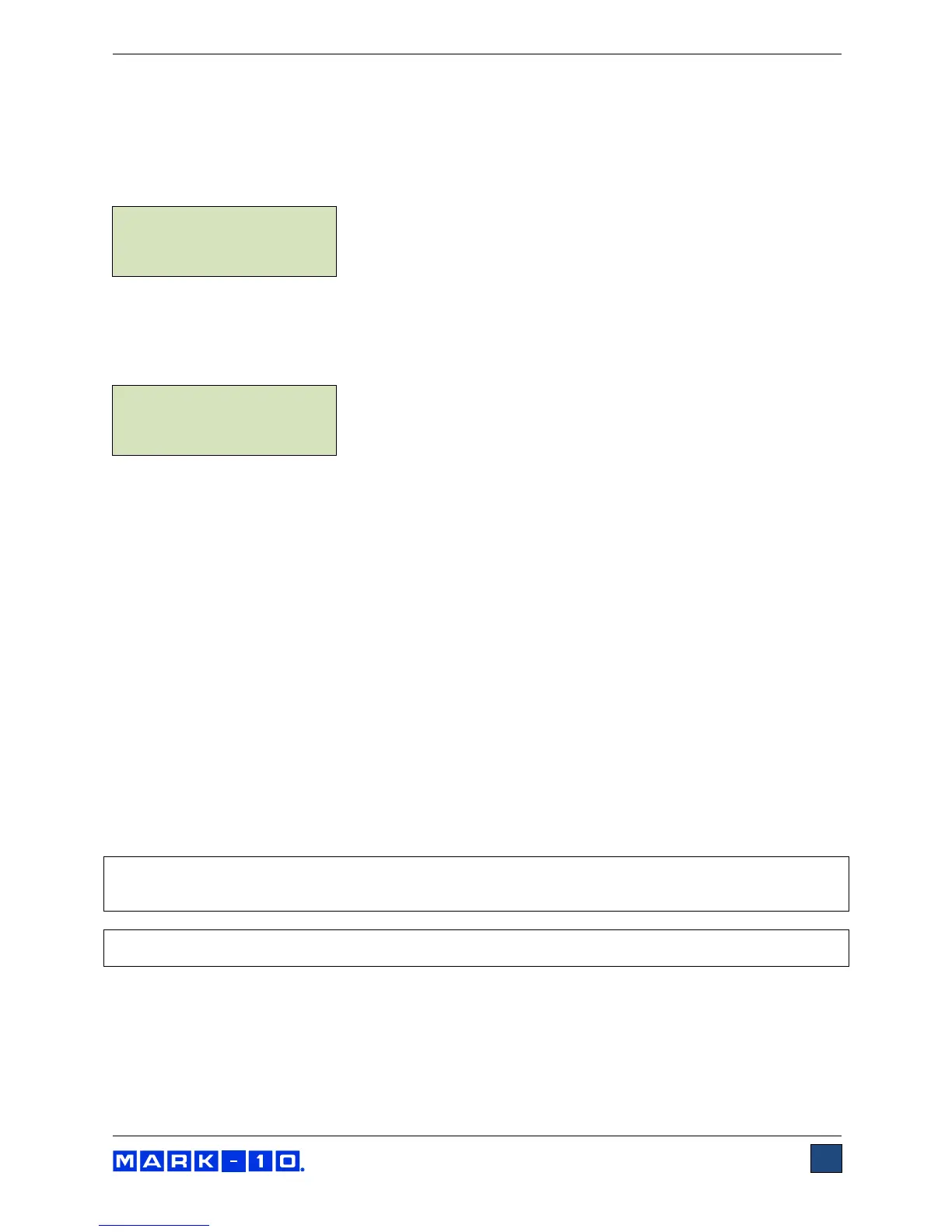
sequence. When the crosshead has reached a limit, a counter will be displayed, shown as follows:
If the dwell settings are set to 0, the crosshead will immediately reverse direction upon reaching the
corresponding limit, and no counter will be displayed.
The cycle sequence may be interrupted before it has been completed by pressing STOP. A soft key
labeled RESET will appear as follows:
At this point, there are two options:
1. Cancel the cycle sequence:
Press RESET to stop and reset the cycle sequence. The cycle counter will revert to the
number of cycles originally programmed.
2. Resume the cycle sequence:
Press either directional button to resume.
Once the sequence has been completed, the screen will revert to the number of cycles programmed
originally. To begin another cycle test, press either directional button.
Travel indication and limit switch operation is the same as in Basic Mode.
5.7 Preload mode
In this mode, the crosshead moves at the set speed (or no greater than 10 in/min [250 mm/min]) until the
programmed preload value has been reached. If moving in the tension direction, a tension preload is
required. If moving in the compression direction, a compression preload is required. When the preload is
reached, the sequence of events programmed in the Preload function occurs. If the ZERO,GO setting is
selected, and if the set speed is greater than 10 in/min [250 mm/min], the crosshead speed will revert to
this setting after the travel indicator is zeroed.
5.8 Load holding mode
In this mode, the crosshead moves until the set point value programmed in the force gauge or indicator is
reached. The crosshead position dynamically adjusts to maintain a programmed force. The force gauge
or load cell’s capacity should be as close as possible to the intended load, for best performance.
In the instrument, both set points must be set. The upper set point refers to a force limit in the tension
direction. The lower set point refers to a force limit in the compression direction. The opposite set point


 To Next Page