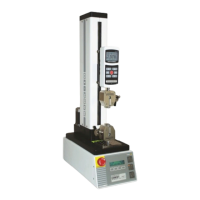
Models ESM303 & ESM303H Test Stands User’s Guide
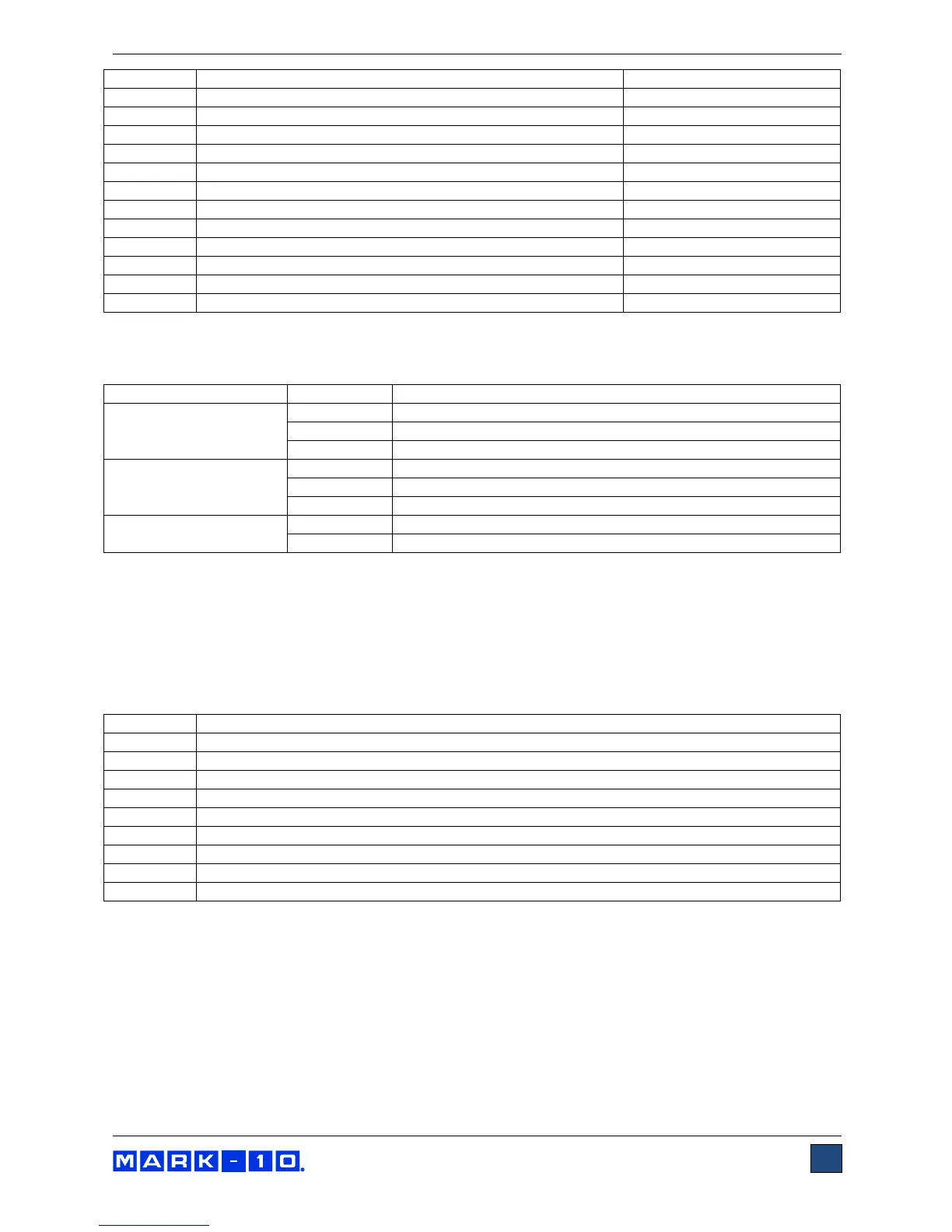
Transmit travel and force readings
Set crosshead speed to programmed speed
Request number of cycles completed
Request number of cycles set
Reset cycle counter to zero
Move crosshead up or right
Request upper travel limit
Request lower travel limit
* The transmission of ASCII “p” will return the stand status. The following are the return codes and their
definitions (upper case):
6.2.1 Force gauge / indicator commands
Mark-10 force gauge and indicator commands are compatible with the ESM303. To open this channel of
communication, use a forward slash “ / “ (no quotations), followed by the commands, followed by a back
slash “ \ “ to close the channel. Refer to the instrument’s user’s guide for a complete list of commands.
The following gauge / indicator commands (upper case) do not require slashes:
Toggles between Normal and Data Collect modes
Steps through Normal mode, Tension Peak mode, and Compression Peak mode
Zeroes the instrument (zeroes all modes)
Sends current mode (Normal, Tension Peak, Compression Peak, or Data Collect)
Sends currently displayed reading
Enables RS-232 output and sends continuous data stream when in Data Collect mode
The ESM303 is compatible with legacy Nexygen
TM
TCD software (not available from Mark-10), which also
utilizes the above commands. Baud rate, stop bits and parity must be configured in the stand to
correspond with the PC software’s settings.
While in PC control, if any functions are changed on the front panel, these settings will be ignored, except
if Auto Return or Cycling are turned on. If so, PC control will be turned off automatically.


 To Next Page