262 | Section 7 LP-Gas System ------------------------------------------------------------------------------------------------------------------------------------------------------------------------------------------------------------------------------- ----------------- Monarch SE 2004
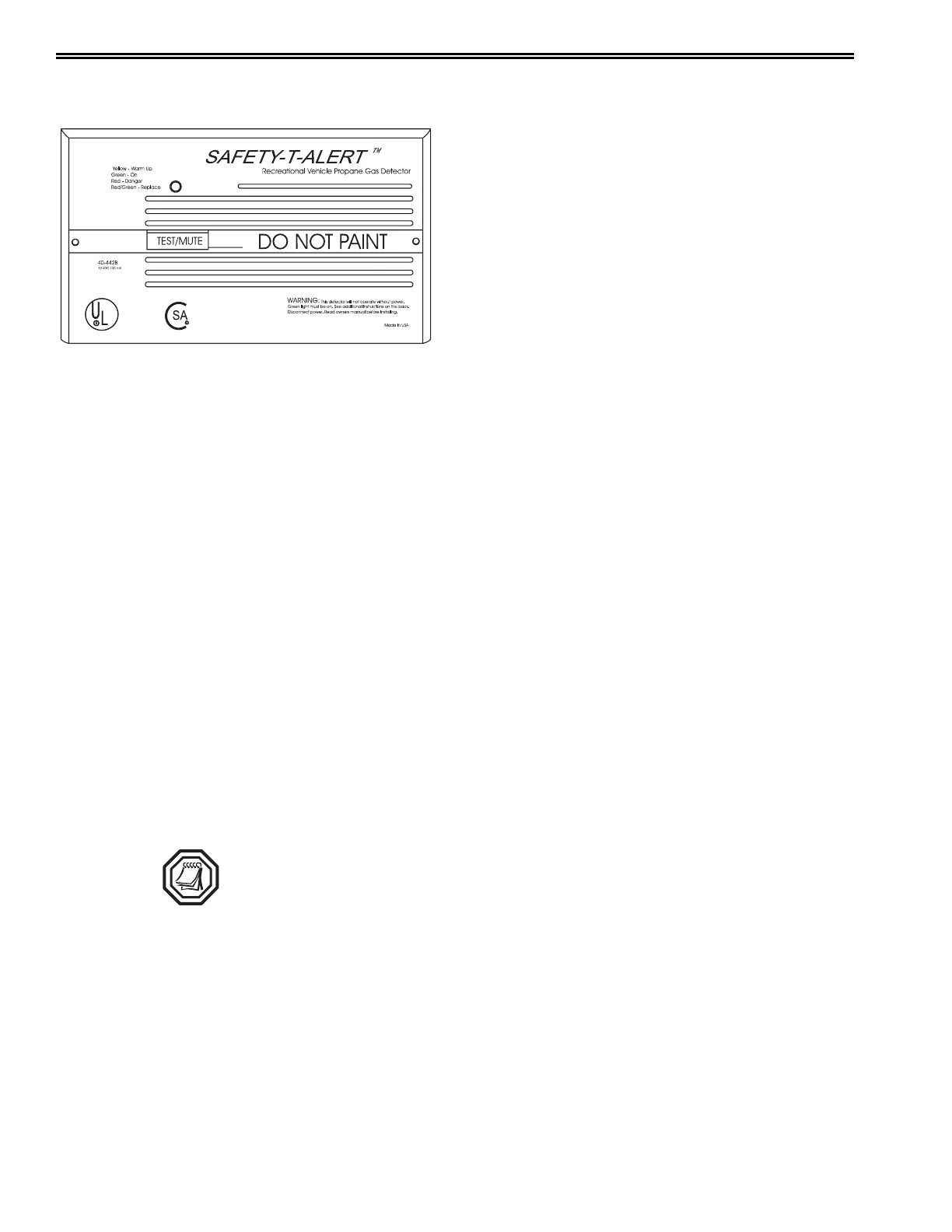
The LP-Gas detector is required safety
equipment in RVs. American National Standards
Institute (ANSI) A119.2 - Fire & Life Safety
3 - 4.8 LP Gas Detectors states " An LP Gas detec-
tor must be installed in any RV that contains an LP
Gas appliance and an electrical system. The LP
Gas detector must be listed as suitable for use in
recreational vehicles under the requirement of UL
1484 Residential Gas Detectors, and installed
according to the terms of its listing."
The detector senses both LP-Gas and methane gas. Liquefied Petroleum (LP)
Gas is heavier than air; methane gas is lighter than air. LP-Gas will settle to the
lowest point, generally the floor of the motorhome. Methane gas will rise. The gas
detector is also sensitive to other fumes such as hair spray, of which most contain
butane as the propellant. Butane, like propane, is heavier than air and will settle to
the floor level where it will be detected. Sulfated batteries (rotten egg odor) will
also sound the alarm. When this occurs, reset the detector to stop the alert sound.
About the LP-Gas Detector:
It is important to be aware of the difference between a gas leak versus gas
escaping from an unlit, open burner. Pure propane vapors from a leaking pipe or
gas fitting are heavier than air and will build up their heaviest concentration at the
leak and float down until they mix with air. Gas from open burners is intentionally
mixed with air to induce burning and will dissipate into the air. When mixed with
air, the gas becomes only marginally heavier than air and will expand outward. If
a gas burner is left on, the area around the burner, range, and adjoining counter
space will be combustible and can cause injury and damage if ignited. This
condition will exist for an extended time period and eventually the gas will reach
the detector's location and be detected.
NOTE: The LP detector only indicates the presence of propane gas at
its sensor. Combustible levels of propane gas may be present in other
areas. This detector is intended for the detection of propane gas ONLY.
LP-GAS DETECTOR
030646



 To Next Page