16
Transmitters use one 3 volt, CR2 Lithium Battery. A Transmitter's
battery should provide normal operation for 1 year or 300 dive
hours. Transmitters check battery voltage when they are pressur-
ized and will send a Low Battery signal to the Receiver in the
VT3 when the voltage drops below the Warning level.
T ransmitter Low Battery Warning/Alarm conditions are only
displayed on Status screens that can be accessed while
viewing the NORM Surface Display .
To check the condition of the VT3 or a Transmitter's Battery if
NORM or GAUG Mode is selected, depress the S button for 2
seconds while viewing the NORM or GAUG Surface Main
Display, then release it.
As the button is depressed, the VT3's Receiver will activate.
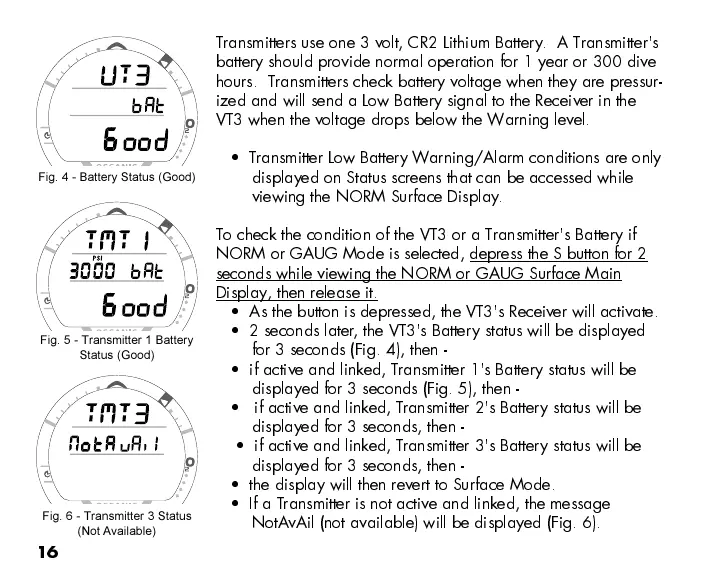
2 seconds later, the VT3's Battery status will be displayed
for 3 seconds (Fig. 4), then -
if active and linked, T ransmitter 1's Battery status will be
displayed for 3 seconds (Fig. 5), then -
if active and linked, T ransmitter 2's Battery status will be
displayed for 3 seconds, then -
if active and linked, T ransmitter 3's Battery status will be
displayed for 3 seconds, then -
the display will then revert to Surface Mode.
If a T ransmitter is not active and linked, the message
NotA vAil (not available) will be displayed (Fig. 6).
Fig. 4 - Battery Status (Good)
Fig. 5 - Transmitter 1 Battery
Status (Good)
Fig. 6 - Transmitter 3 Status
(Not Available)



 To Next Page