175
Using Tasks Section 4-2
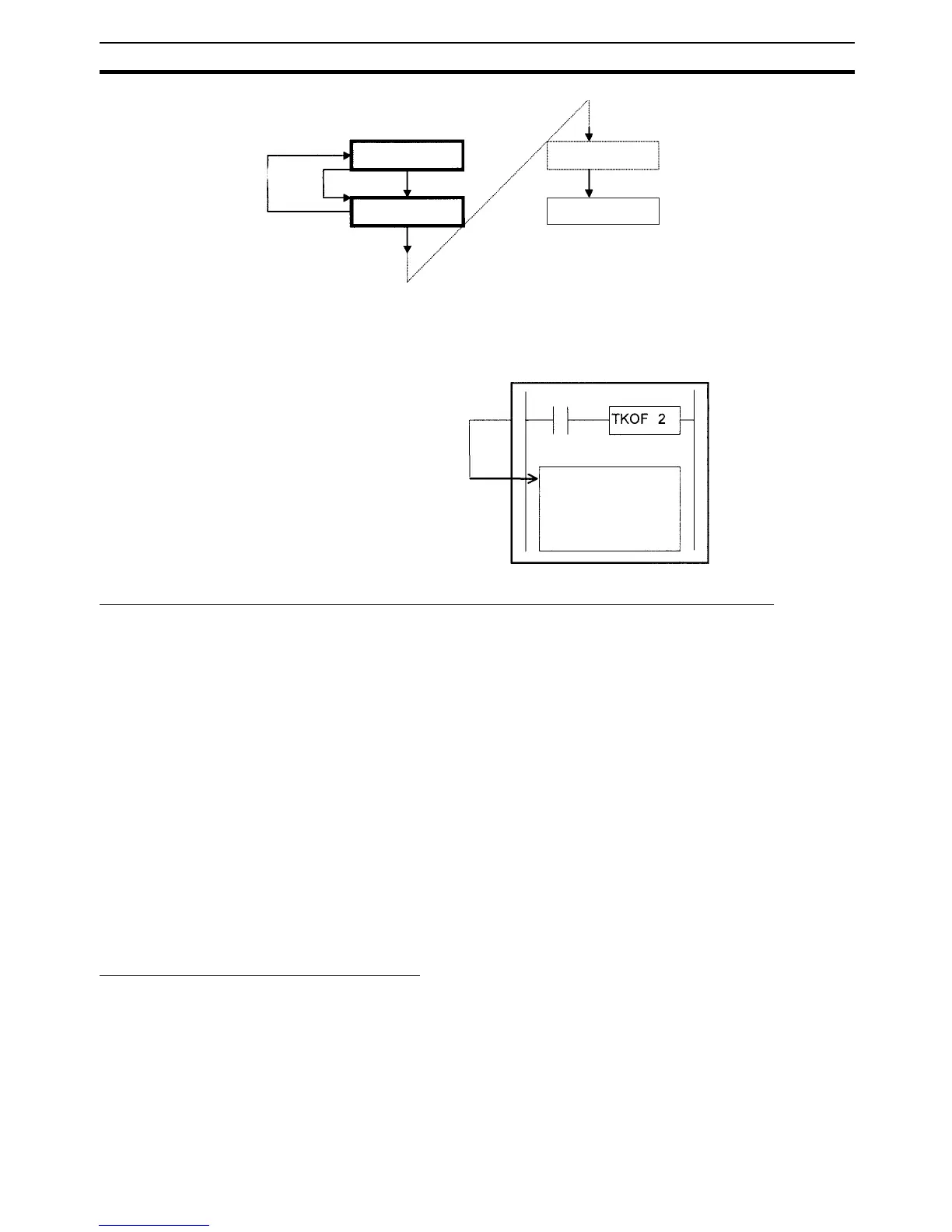
If a TKOF(821) instruction is executed for the task it is in, the task will stop
being executed where the instruction is executed, and the task will shift to
Standby status.
Cyclic Task Numbers and the Execution Cycle (Including Extra Cyclic Tasks)
If task m turns ON task n and m > n, task n will go to READY status the next
cycle.
Example: If task 5 turns ON task 2, task 2 will go to READY status the next
cycle.
If task m turns ON task n and m < n, task n will go to READY status the same
cycle.
Example: If task 2 turns ON task 5, task 5 will go to READY status in the
same cycle.
If task m places task n in Standby status and m > n, will go to Standby status
the next cycle.
Example: If task 5 places task 2 in Standby status, task 2 will go to Standby
status the next cycle.
If task m places task n in Standby status and m < n, task n will go to Standby
status in the same cycle.
Example: If task 2 places task 5 in Standby status, task 5 will go to Standby
status in the same cycle.
Relationship of Tasks to I/O Memory
There are two different ways to use Index Registers (IR) and Data Registers
(DR): 1) Independently by task or 2) Shared by all task (supported by CS1-H,
CJ1-H, CJ1M, or CS1D CPU Units only).
With independent registers, IR0 used by cyclic task 1 for example is different
from IR0 used by cyclic task 2. With shared registers, IR0 used by cyclic task
1 for example is the same as IR0 used by cyclic task 2.
The setting that determines if registers are independent or shared is made
from the CX-Programmer.
Cyclic task 1
Cyclic task 2
Cyclic task 1
Cyclic task 2
TKOF(821)
TKON (820)
RUN status
Standby status
RUN status
Standby status
Task execution will
stop here and the task
will shift to Standby
status.
Task 2




 To Next Page