2.6
Section 2
Overview
Pinnacle Operators Manual
Pickering Laboratories Inc.
Reagent tubing is pre-connected to the pump at the factory. All
Reagents lines are Air Barrier tubing. Reagent 1 is labeled R1,
and Reagent 2 is labeled R2 throughout the instrument. Nuts
and ferrules (1/4-28 ) are provided for connecting the tubing
to the Reservoir caps.
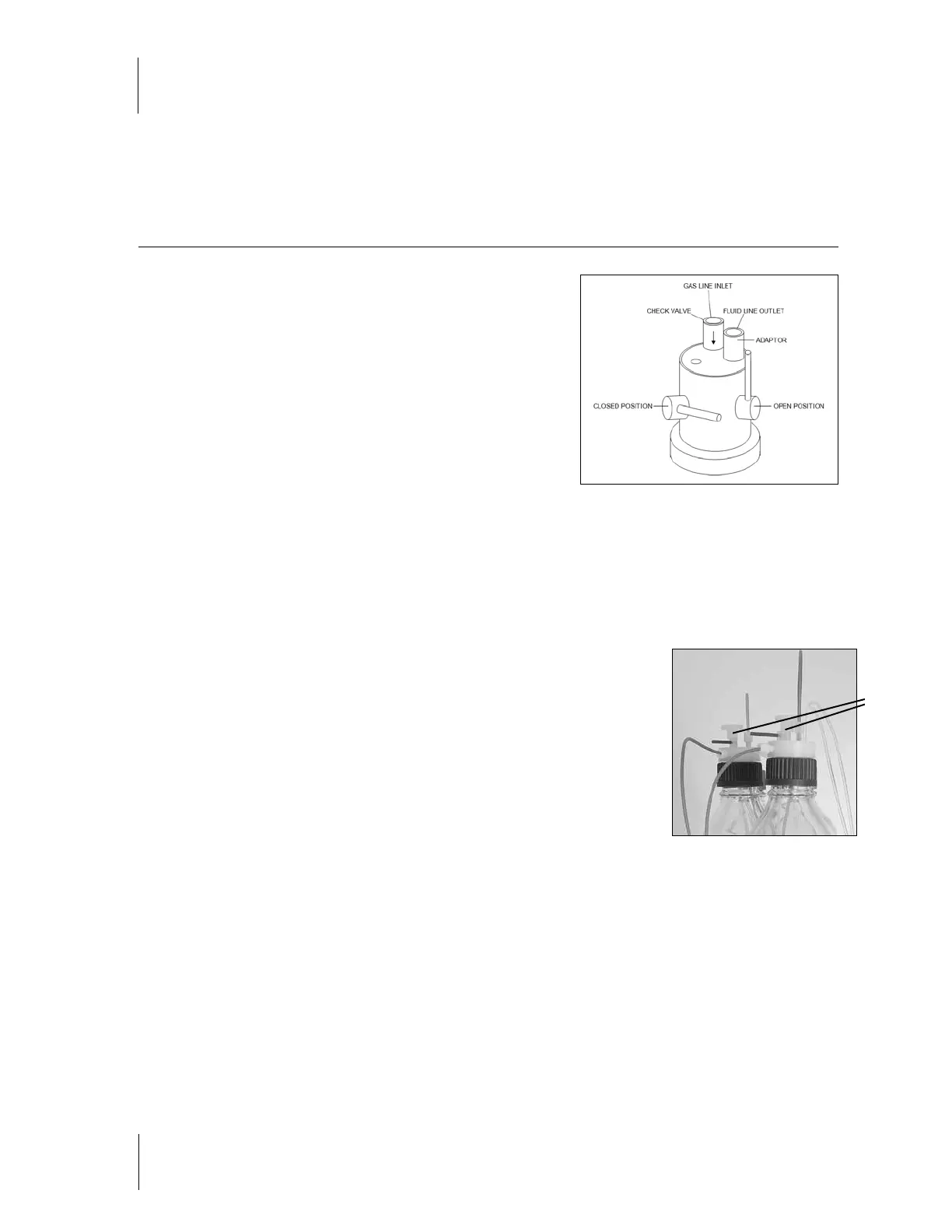
The reservoir cap (Figure 2-7A) has two connecting ports
on the top – one for connecting reagent line and one for
connecting the gas line. The port for the gas line has a one-way
valve to prevent backflow of the reagent into the gas manifold in
case of a drop in gas pressure. Use nuts and ferrules (1/4-28)
to make the connections. There are two stopcocks, one is for
the vent port and the other is for the reagent line. Keep reagent line stopcock open for operation. Open the vent
stopcock to sparge the reagent and close it to pressurize the reservoir. This is the normal operating position.
When changing reagent, first turn off the gas using the toggle valve on the fluidics panel. Then vent the reagent
bottle by opening vent stopcock. Now you can safely remove the cap. It is convenient to have extra bottles
so that you can simply transfer the cap without setting it down and risking
contamination.
If you have a reservoir cap shown on figure 2-7B, the large white knob is the
valve; pull it up for CLOSED, and push it down for OPEN. If the gas is turned on,
opening the vent valve will sparge the reagent. Closing the valve will pressurize the
reservoir; this is the normal operating position. On the side of the cap, away from
the on-off valve, there is a 1/4-28 fitting; you may optionally connect a tube here
to carry vapors to an exhaust vent.
Warning. For your safety, the bottles are coated with a tough plastic film and are
rated to a maximum of 15 psig (1 bar). Do not use uncoated bottles.
Attention. Pour votre sécurité, les bouteilles sont recouvertes d’un film de plastique dur, et sont calibrées à un
maximum de 10 psig (0.7 bar). Ne pas utiliser les bouteilles non recouvertes.
Warnung! Für Ihre Sicherheit wurden die Reagenzienflaschen mit einem festen Schutzüberzug aus Kunststoff
versehen. Die Flaschen sind bis max. 0.7 bar (10 psig) zugelassen Flaschen mit beschädigtem Schutzüberzug
dürfen nicht mehr benutzt werden Verwenden Sie keine Flaschen ohne Schutzüberzug!
Atención. Para su seguridad, las botellas están recubiertas con una resistente película plástica, y están
constrastadas a 10 psig (0.7 bar). No utilice botellas sin recubrimiento.
Avvertimento. Per la sua protezione, le bottiglie sono construite forti con un percentuale du plastica, e sono
usabili per un massimo di 0.7 Bar (10 psi). Non usare bottiglie normali.
Figure 2-7A
Figure 2-7B
Valve



 To Next Page