2.5
Section 2
Overview
Pinnacle Operators Manual
Pickering Laboratories Inc.
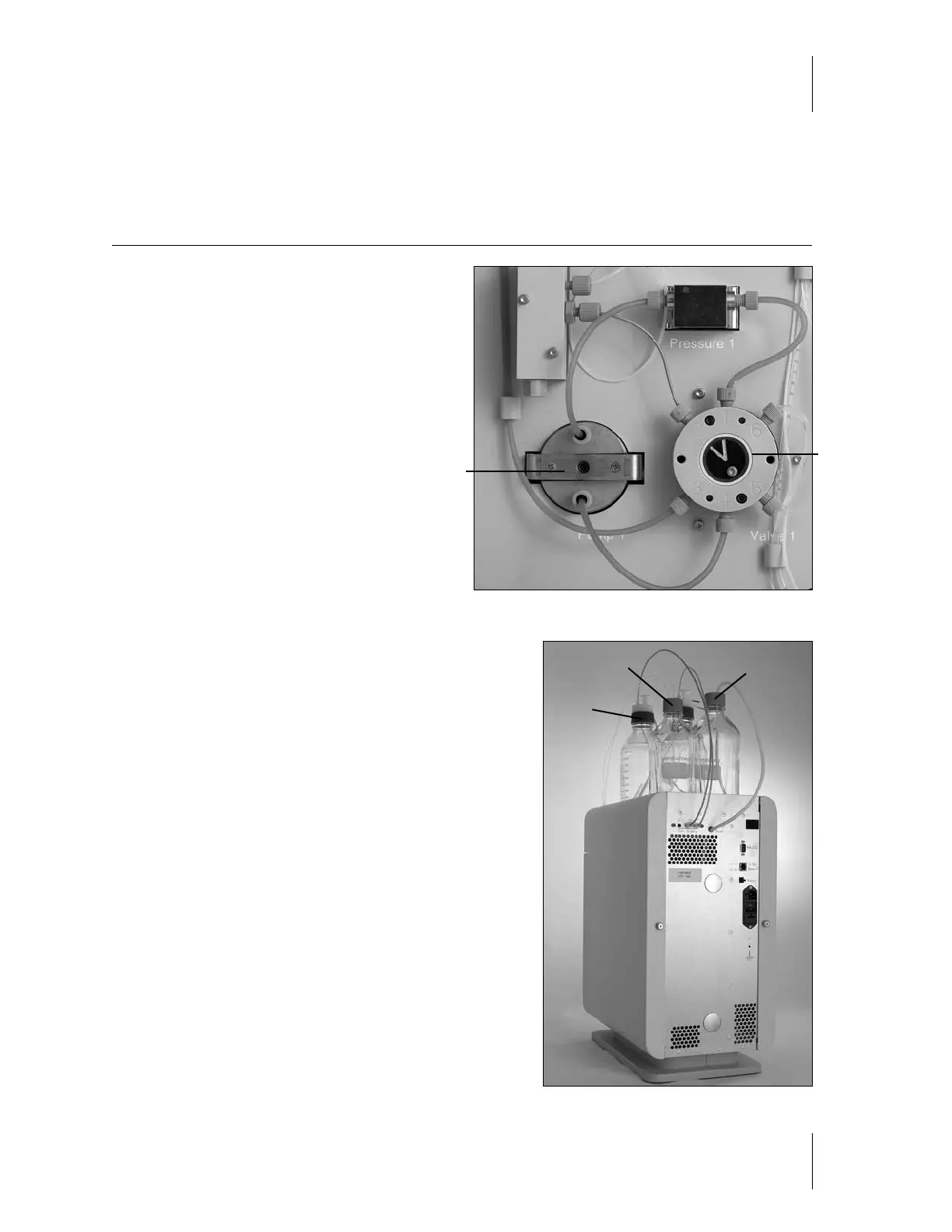
Reagent Valves
Reagent Valves are placed immediately after
the pump. The valves have 5 possible operating
positions:
1)
REAGENT: From Reagent Bottle to Pump (3-4)
2)
REACTOR: From Pump to Reactor (1-2)
3)
WASTE: From Pump to Waste (1-6)
4)
FLUSH: From Flush Bottle to Pump (5-4)
5)
BLOCKED: The valve ports are blocked.
The valves are connected to a Flush Bottle which
can be used to flush the reactor in the event of a
shutdown or to aid in flushing the system. This will
reduce the likelihood that the reactor becomes
blocked. The valves are also connected to the
reagent bottles and are used for filling the syringe pump.
Reservoir Tray / Bottles
This is the tray located on top of the instrument. It holds the
reagent bottles, wash bottle and flush bottle. It is removable
for cleaning. It will hold 1L of liquid and as such is considered
secondary containment. It does not seal any openings at the top
of the instrument in case of heavy spillage.
There are 4 bottles located here:
1. Reagent Reservoir 1
2. Reagent Reservoir 2
3. Flush Bottle – contains water or 80-20 water/alcohol (IPA or
Methanol) for flushing the instrument.
4. Piston Wash bottle – contains 90-10 water/alcohol (IPA or
Methanol). This bottle is connected via 1/4 inch OD flexible
tubing to the piston wash of each pump in the instrument.
Change Wash and Flush solutions at least once a week to prevent
contamination.
The pressurized reagent reservoir serves two purposes:
It protects air-sensitive reagents from oxidation.
It helps the syringe pump fill consistently and quickly by
providing a source of pressure.
Reagent
Piston
Wash
Flush
2
1
6
5
3
4
Valve
Pump
Figure 2-5
Figure 2-6



 To Next Page