4.9
Section 4
Pinnacle PcX OPeratiOn
Pinnacle Operators Manual
Pickering Laboratories Inc.
Reagent 2 Enter the name or description of Reagent 2. Any characters are acceptable. There is no limit on
number of characters, but 20 are visible in the window at a time.
ADVANCED SETTINGS
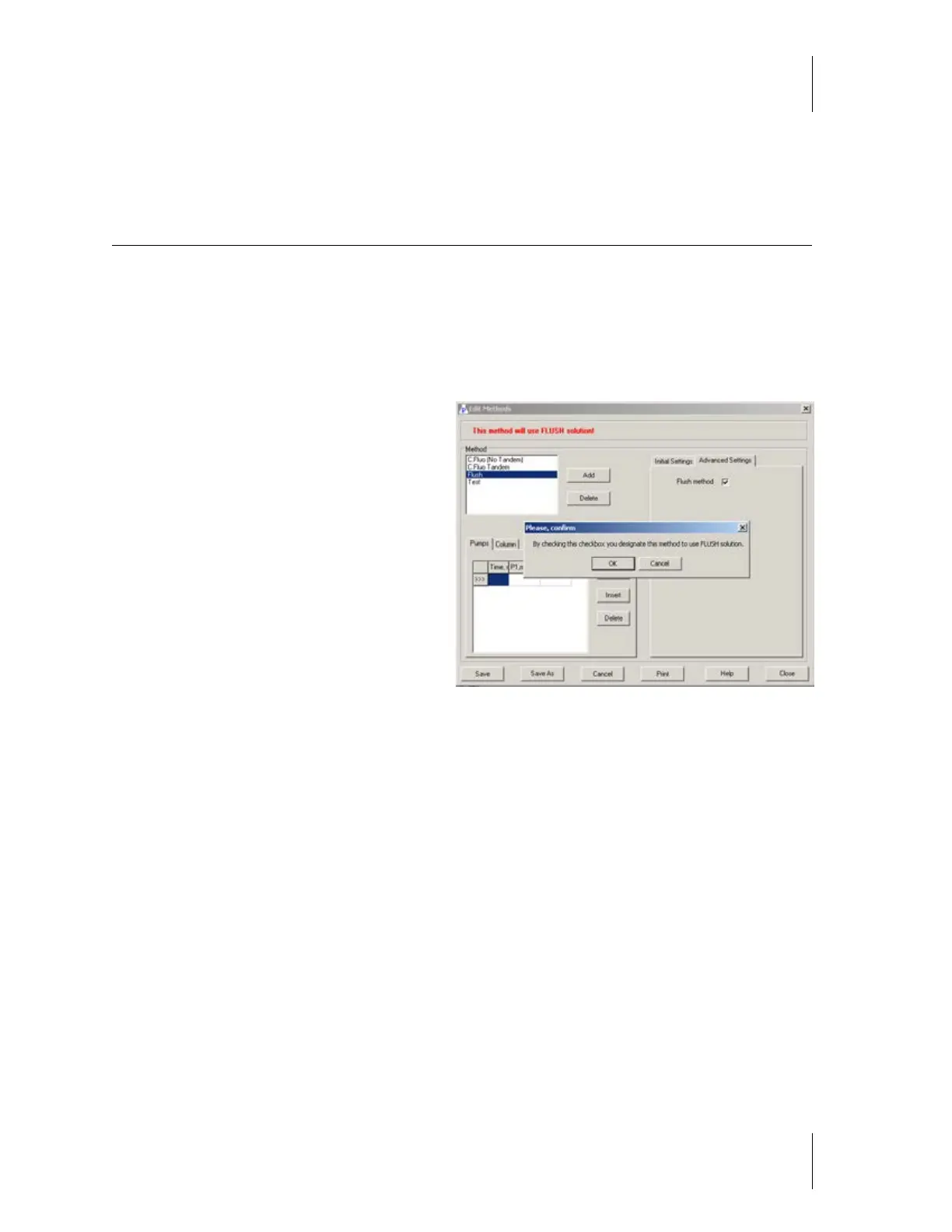
This tab allows you to designate currently open method as a Flush Method (figure 4-4). This method can be
set as a last method in the Pinnacle PCX sequence in order to flush the reagent pumps and the Pinnacle PCX
reagent lines and reactor. Pinnacle PCX will use
solution in the Flush bottle to do this. Always
set Flush Method as the last method in the
sequence and make sure corresponding HPLC
method is created and set as the last method in
the HPLC sequence. Flushing is not necessary
after every sequence and only recommended
before changing applications and long time
storage or in the case of extremely aggressive
reagents.
ACTION TABS
Save
This will save the current method
Save As This will save the current method
information using a different name.
Cancel This will close the window and cancel any changes. No changes will be made to the method.
Print This will print the method to the default printer. The information printed will be: print date, operator,
method name, save date, initial conditions, pump time table, column time table.
Help This will open the searchable Help features for the Pinnacle PCX software.
Close This will close the window.
IMPORTANT PRACTICAL CONSIDERATIONS
In order to start executing the method Pinnacle PCX needs to receive injection signal from HPLC. To avoid
missing the signal it is very important to match Pinnacle PCX method run time and equilibration time to that of
your HPLC method.
HPLC pump uses equilibration to return to original conditions before the next analysis. HPLC software
programs have different ways of setting up equilibration. Most often used are the following:
- as a PostRun;
- at the end of the pump gradient table;
- as additional time before the injection (set as a PreRun or as negative time in the pump gradient table).
Figure 4.4



 To Next Page