6.2-1
Section 6
ApplicAtions
Pinnacle Operators Manual
Pickering Laboratories Inc.
Background
The separation is a multi-modal process wherein ion-exchange, ion-exclusion, and partition all take place.
The primary process is cation-exchange where a pH gradient mobilizes amino acids in order of their isoelectric
points; acidic amino acids such as glutamic acid elute early and basic amino acids such as lysine elute late.
Partitioning is affected by ionic strength and organic modifiers; for example threonine and serine are resolved
by partition effects. Ion-exclusion only occurs for highly acidic amino acids such as taurine.
Sodium ion-exchange is used for fast analysis of the 22 amino acids found in hydrolyzed protein or in simple
formulated products. Lithium ion-exchange is a slower technique with higher resolution to separate as many as
46 amino acids and compounds found in the complex mixtures of biological fluids or tissue extracts.
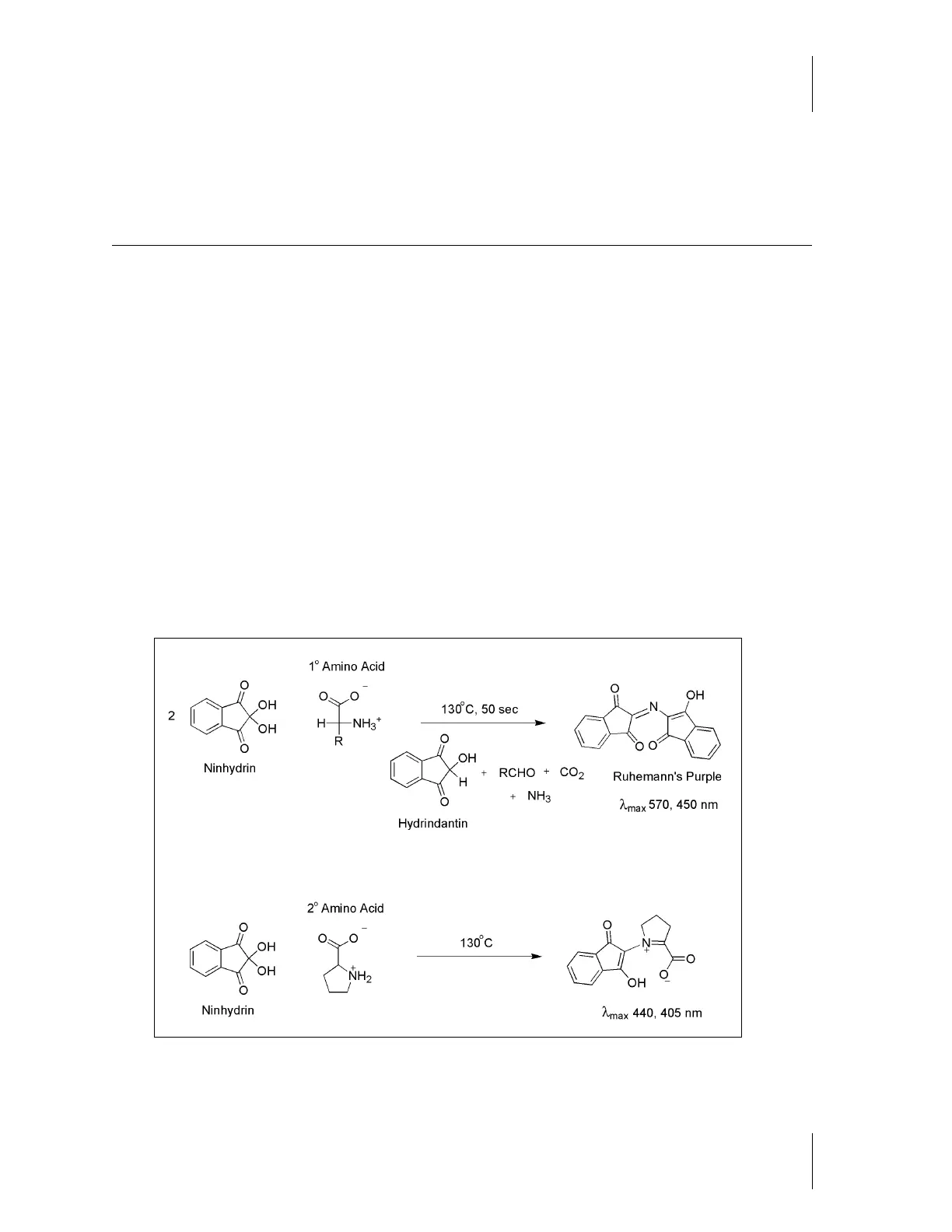
The most popular reagent for post-column detection is ninhydrin. Ninhydrin reacts with primary amines and
hydrindantin to form Ruhemann’s Purple (Figure 6.2-A) which is detectable at 570nm. Ninhydrin reacts with
secondary amines to form a yellow complex detectable at 440nm. The ninhydrin reaction is carried out at
130°C with a reactor volume of 500 µl. The elevated temperature is required because at room temperature,
the ninhydrin reaction is very slow and takes hours to go to completion.
Figure 6.2-A



 To Next Page