User Manual Bearing System RT-300
Issue: 2017/06/27 [Rev 1.04.c] Page 25 of 79 12-9-1-0013-9-2-0001-3-1-60
5.2.6.2 Activating / Deactivating „Selective Squelch“
Activating:
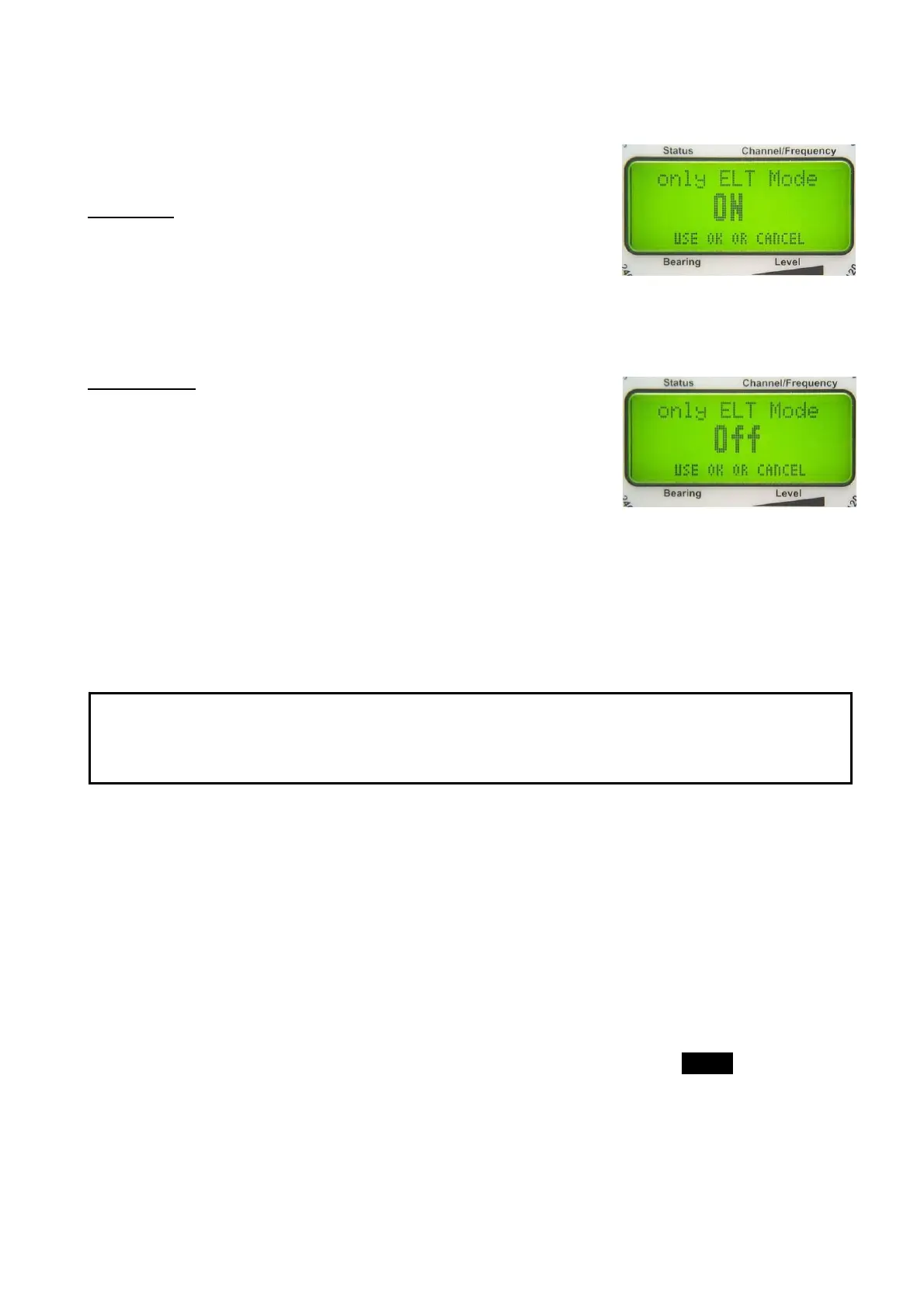
Key 4 < ELT only > is opening a window as shown in Fig. 21. If
confirming with key 6 < Ok > within 5 sec, the “selective
squelch” is activated and the device is returning in bearing
mode. If not confirming within that time, the selected status will
remain. The display is showing the selected function „O-ELT“(see Fig. 7: Display).
O-ELT means: Only Emergency Locator Transmitter.
Deactivating:
Key 4 <ELT only> is opening a window as shown in Fig. 22.
Now confirming with key 6 <Ok> within 5 sec, the selective
squelch is deactivated and the device is returning in bearing
mode. If not confirming within that time, the selected status will
remain. The display is not showing the selected function „O-
ELT“(see Fig. 7: Display) anymore.
NOTE
The “selective squelch” activated, only signals in the airband with the typical ELT-sweep tone
modulation will be beared. All other signals will be suppressed. The “selective squelch” can only
be activated in the airband.
5.2.7 Scan Function: Key 12 < Scan >
5.2.7.1 Common Remarks
The bearing system RT-300 is equipped with only one receiver. If working in the UHF airband,
signals in the VHF airband cannot be recognized and vice versa. So, a certain risk exists not to
receive a distress signal and not activating the alarm. In order to prevent this case the scanning
function SCAN was installed.
If the SCAN-function is activated, every 30 sec the device is switching over from the working
frequency to the distress frequency 121.500 MHz, but only during a gap of reception. Is a signal
received on 121.500 MHz, the device will remain tuned on the distress frequency. The alarm
contact will be actuated (see 6.2.1.5.5.1). While scanning, the message SCAN in the display is
shown inverted, and in the frequency display 121.500 MHz will be indicated.
If no signal is received, the device switches back to the previous working frequency.
NOTE
The function SCAN can be combined with function “selective squelch”.
Fig. 21
Fig. 22
ATTENTION
At very weak signals detection may take a certain time or even be impossible. In
this case alarming is delayed or not possible.


 To Next Page