Serial Communications Page 7-
_________________________________________________________________
Section 7 Serial Communications
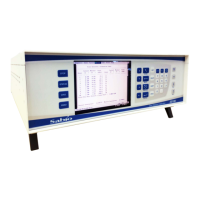
The Model 2010D incorporates a serial RS-232 port, which can be
attached to a modem or personal computer for remote
configuration, operation, control and for updating the operating
program.
The remote terminal feature allows a user to remotely interact
with the 2010D. While in this "terminal mode", the user can view
an exact image of the 2010D's display on a remote terminal screen
and access any function that is available on the unit’s front
panel.
In addition to terminal mode, the Model 2010D supports a serial
command mode. This mode makes it possible to interact with the
unit via the serial communications port using a protocol more
suitable for remote control by a computer.
Using serial commands, sequences and points can be started or
stopped and several other 2010D features can be accessed. This
capability opens up a number of applications involving remote
control of the Model 2010D by local or remotely located PCs or
direct control by a datalogger.
Operating Modes
There are two modes of operation for the serial ports: terminal
mode and command mode. Terminal mode allows a user to interact
with the 2010D using a remote terminal. Command mode allows
another computer or datalogger to control and monitor the 2010D
using a command protocol. Both operating modes may be used on
the same serial port, however the correct mode of operation must
be selected first. Following are descriptions of how to change
modes.
Terminal Mode If the remote terminal is enabled when
the 2010D first powers up, the terminal
mode will automatically be selected and
a log-in will be requested. If command
mode is active, terminal mode can be
selected by pressing the ESC key twice
in succession. This will cause the
2010D screen to appear on the remote
terminal.


 To Next Page